- Vancouver 360-369-3586
- Portland 503-925-3504

The Hidden Dangers of Galvanized Steel Pipes in Older Pacific Northwest Homes
by writer | Dec 31, 2025
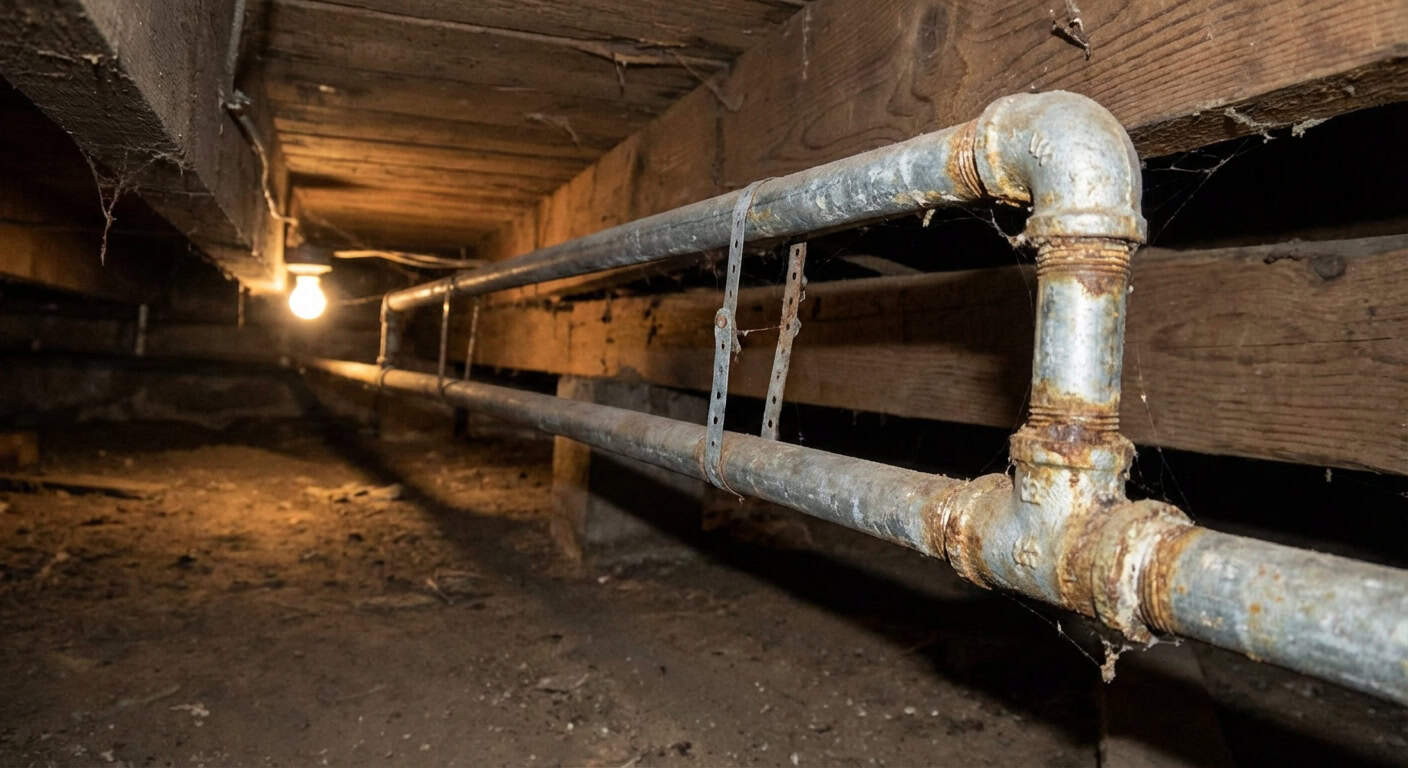
Table of Contents
- The Rise and Fall of Galvanized Steel Plumbing
- Tuberculation: The Silent Plumbing Killer
- Soft Water, Hard Truth: Why PNW Homes Fail Faster
- Hidden Toxins: Why Galvanized Pipes Are a Lead Poisoning Risk
- Uninsurable: The Financial Time Bomb of Galvanized Plumbing
- DIY Detection: 3 Tests Every Homeowner Should Try
- Future-Proofing Your Home: The Case for PEX and Copper Repiping
- Final Thoughts
Your charming 1950s Craftsman or cozy Mid-Century Modern home in Vancouver or Portland has undeniable character—hardwood floors, original fixtures, and a story in every corner. But behind those walls, a silent crisis may be brewing. If your home was built before 1980 and still has its original plumbing, you’re living with galvanized steel pipes that have likely exceeded their 40-50 year lifespan. Here’s the uncomfortable truth: 56% of homes in the Portland-Vancouver metro area were built before 1980, placing over half the region’s housing stock in the high-risk zone for catastrophic plumbing failure. Unlike the visible charm of your home’s exterior, galvanized pipes deteriorate from the inside out—corroding, leaching heavy metals like lead into your drinking water, and restricting flow until they eventually burst. The Pacific Northwest’s naturally soft water accelerates this decay, and insurance companies are taking notice. Many carriers now refuse coverage or deny water damage claims on homes with galvanized plumbing. In this article, we’ll uncover:
- Why galvanized pipes fail faster in the PNW
- The health risks of lead contamination
- How to identify if your home is at risk
- Why modern materials like PEX and copper are essential upgrades
- Real costs of failure vs. proactive repiping
Let’s dive into what every PNW homeowner with an older home needs to know.
The Rise and Fall of Galvanized Steel Plumbing
Understanding the historical context of galvanized pipes helps homeowners recognize why these systems are now obsolete and dangerous. From the 1930s through the 1970s, galvanized steel was the gold standard for residential plumbing across America. These pipes were manufactured by coating steel in molten zinc, creating what engineers believed would be a durable, corrosion-resistant system. The strength of steel combined with the protective zinc layer seemed like the perfect solution for delivering clean water to growing suburban communities. But there was a fatal flaw hidden in the chemistry.
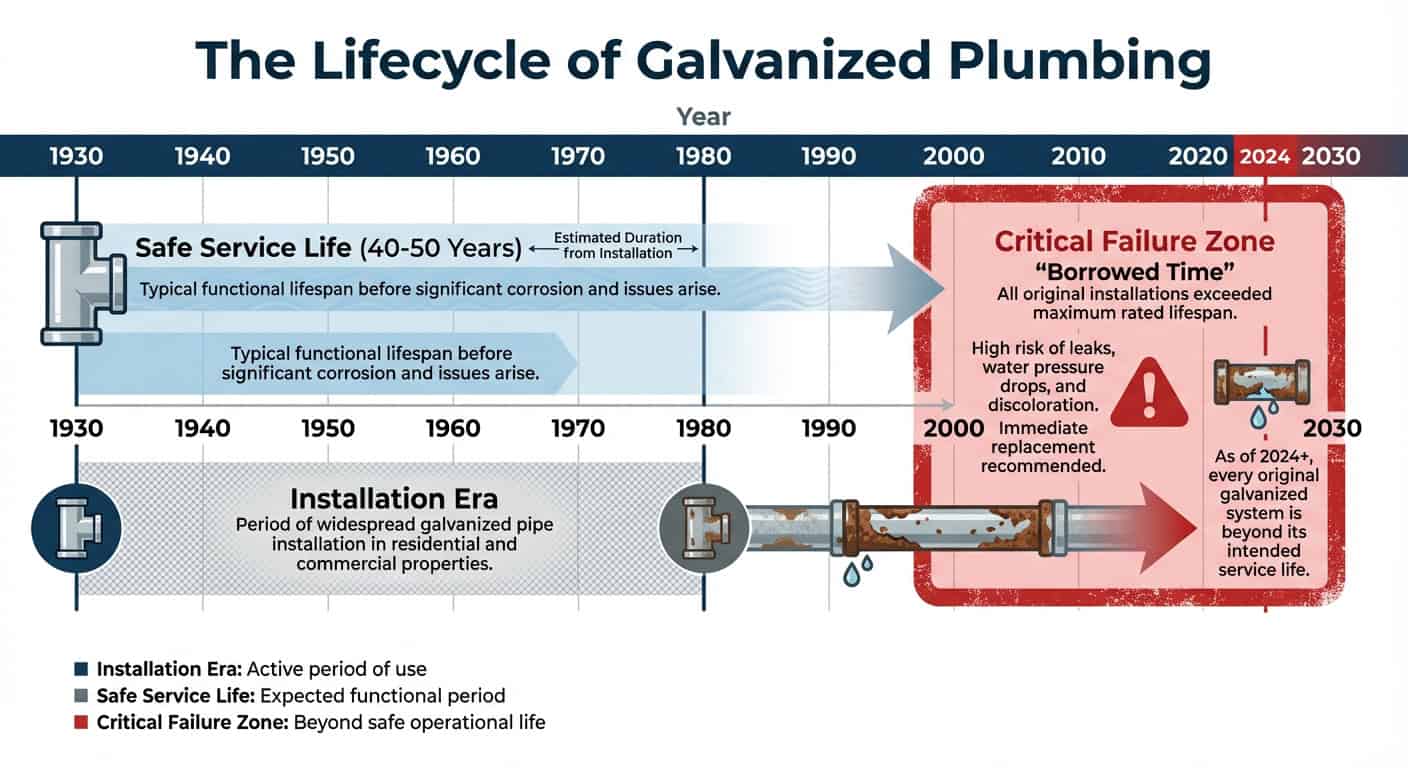
The zinc coating applied to these pipes wasn’t chemically pure. Manufacturers used “Prime Western” grade zinc, which naturally contained lead and cadmium impurities. As the protective zinc layer gradually wears away through decades of use, these trapped heavy metals leach directly into your drinking water. What’s worse, the underlying steel begins its inevitable transformation into rust. Here’s the critical issue most homeowners don’t realize: galvanized pipes were engineered with a 40-50 year service life. This wasn’t a conservative estimate—it was the maximum expected lifespan. Any home built before 1980 with original plumbing is statistically overdue for failure. The pipes in your walls are operating on borrowed time. By the 1970s, the plumbing industry recognized the mounting problems with galvanized systems. Health concerns about lead exposure, combined with widespread reports of premature corrosion and flow restrictions, prompted a shift to copper piping. Today, modern materials like PEX (cross-linked polyethylene) have largely replaced both galvanized steel and copper in new construction, offering superior performance without the corrosion risks. If your home still has its original galvanized plumbing, you’re not just living with outdated technology—you’re living with a system that has exceeded its engineered lifespan by decades.
Tuberculation: The Silent Plumbing Killer
Unlike copper pipes that develop pinhole leaks, galvanized pipes fail through internal buildup that chokes water flow and harbors dangerous bacteria. The corrosion process in galvanized pipes operates fundamentally differently than in other plumbing materials. As the protective zinc coating deteriorates, the underlying steel is exposed to oxygen and water. This triggers a chemical reaction that forms iron oxide—rust. But unlike the erosion you might see on the exterior of metal exposed to weather, this rust doesn’t wash away. It accumulates.
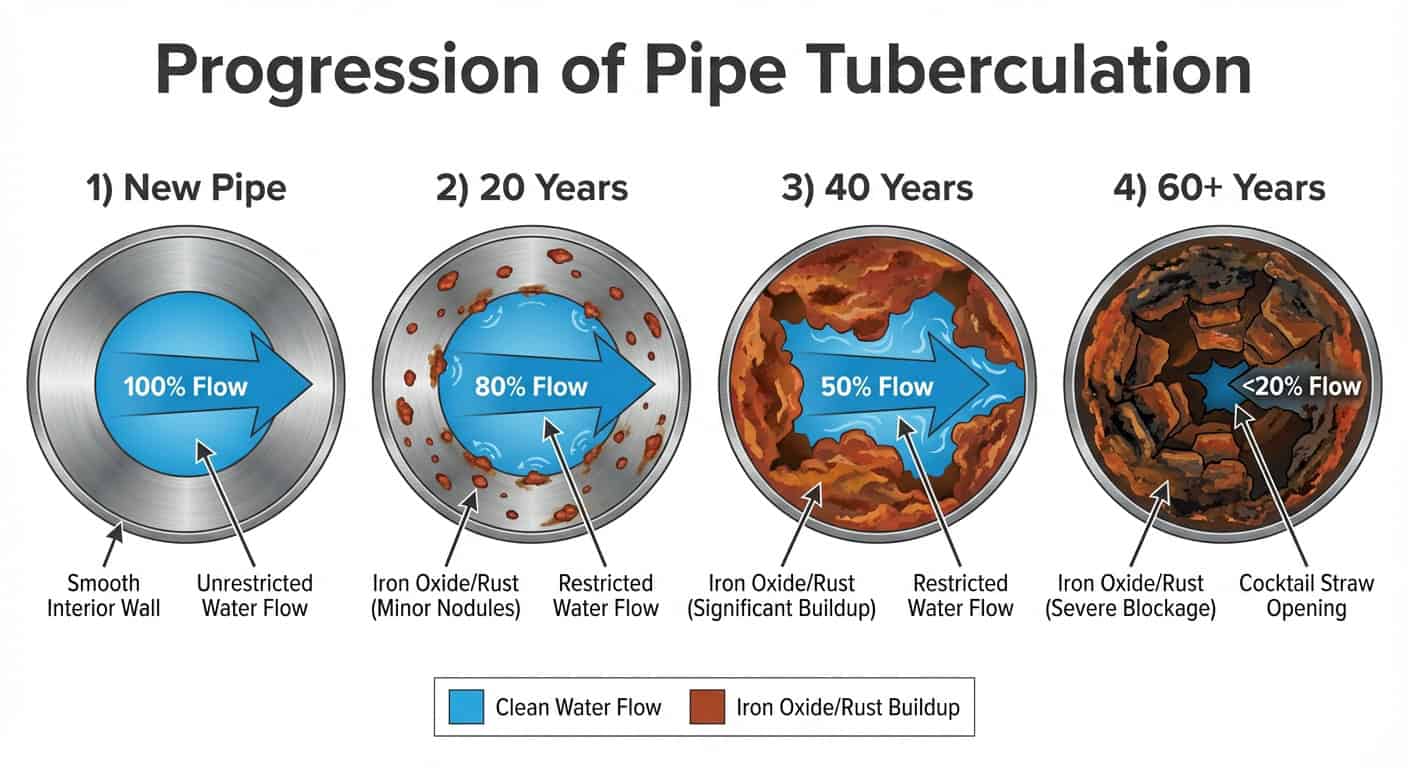
This accumulation process is called tuberculation, and it’s the primary mechanism of failure in galvanized systems. The rust deposits form mound-like structures on the interior walls of the pipe, gradually building up layer after layer. Over decades, these formations can reduce a 1-inch diameter pipe to the flow capacity of a cocktail straw. The first symptom most homeowners notice is declining water pressure. You might find that your shower doesn’t have the same force it once did, or that running multiple faucets simultaneously causes a noticeable pressure drop. These aren’t minor inconveniences—they’re warning signs that your pipes are severely compromised from within.
- Significant water pressure drop when running multiple fixtures
- Rust-colored or brownish water, especially after the system has been idle
- Metallic taste in drinking water
- Visible rust stains on fixtures and in sinks
- Extended wait time for hot water delivery
But tuberculation creates risks beyond reduced flow. The rough, porous surface formed by these rust deposits provides an ideal breeding ground for bacterial biofilms. Research has shown that bacteria like Legionella and E. coli can colonize these irregular surfaces, where they’re partially shielded from the chlorine disinfection present in municipal water supplies. When you turn on your shower, these bacteria can become aerosolized and pose respiratory health risks. Here’s what makes tuberculation particularly insidious: you can’t fix it. Unlike a clogged drain that can be snaked clear or a buildup of mineral deposits that can be chemically treated, tuberculation is structural damage to the pipe itself. The corrosion has fundamentally altered the interior of the pipe. Short of complete replacement, there’s no solution. Homeowners sometimes attempt partial repairs, replacing visible sections where leaks have developed. But this approach fails to address the systemic nature of the problem. If one section has corroded enough to leak, the rest of the system is likely in similar condition—you’re just waiting for the next failure point to reveal itself.
Soft Water, Hard Truth: Why PNW Homes Fail Faster
The region’s naturally soft water creates a unique chemical environment that aggressively attacks galvanized pipes, accelerating their decay compared to other parts of the country. The Pacific Northwest’s water quality is something of a double-edged sword. Water sourced from Portland’s Bull Run Watershed and Vancouver’s local aquifers is prized for being “soft”—meaning it has low concentrations of dissolved minerals like calcium and magnesium. This makes our water excellent for bathing, laundry, and cleaning (no soap scum or hard water stains), but it creates a serious problem for aging metal pipes. In regions with hard water, dissolved minerals naturally precipitate out and form a thin layer of calcium carbonate scale on the interior of pipes. While this scale can eventually cause its own problems, it initially acts as a protective barrier, slowing the direct contact between water and metal. The Pacific Northwest’s soft water lacks these minerals, leaving nothing to buffer the aggressive chemical interaction between water and the zinc coating on galvanized pipes. The result? PNW homes experience galvanized pipe failure 15-20% faster than the national average. While a home in the Midwest might see its galvanized system last 50-55 years before critical failure, a comparable home in Vancouver or Portland is more likely to experience problems at 40-45 years. There’s another regional risk factor that accelerates corrosion: galvanic reactions from partial repairs. When homeowners replace a failed section of galvanized pipe with modern copper (a common approach in the 1980s and 1990s before full home repiping became standard), they unknowingly create an electrochemical cell. The dissimilar metals—copper and galvanized steel—connected in the presence of water act like a battery. This galvanic corrosion dramatically accelerates the deterioration of the galvanized section, often causing new leaks near the connection point within months. This phenomenon is particularly common in homes where additions or bathroom remodels were completed in recent decades using copper, while the main house retains original galvanized lines. The mixing of plumbing materials isn’t just an aesthetic concern—it’s a chemical recipe for accelerated failure. The soft water chemistry combined with the age of our regional housing stock creates a perfect storm. If you own a pre-1980 home in the Portland-Vancouver metro area, the question isn’t whether your galvanized pipes will fail—it’s when, and whether you’ll address the issue proactively or reactively.
Hidden Toxins: Why Galvanized Pipes Are a Lead Poisoning Risk
Beyond structural failure, galvanized pipes pose serious health risks through lead contamination—a danger that increases unpredictably over time. Lead exposure from drinking water isn’t just a concern for cities with old lead service lines—it’s also a significant risk in homes with galvanized plumbing. The zinc coating that was supposed to protect these pipes contained lead and cadmium impurities. As the pipes corrode over decades, these heavy metals become trapped in the layers of rust and scale accumulating on the interior walls. This creates what water quality experts call the “piggyback” effect. Lead particles aren’t constantly present in your water—they’re embedded in the tuberculation. But when something disturbs the pipe—construction vibrations, water hammer from quickly closing a valve, or even the normal turbulence of turning on a faucet—chunks of scale can break loose, causing sudden, unpredictable spikes in lead concentration at your tap.
Health Risks of Lead Exposure
The Environmental Protection Agency has stated unequivocally: there is no safe level of lead exposure. Even low-level chronic exposure, particularly in children under six and pregnant women, can cause:
- Developmental delays and reduced IQ
- Behavioral issues and learning disabilities
- Impaired growth and hearing problems
- Nervous system and kidney damage
- Reproductive complications
Here’s what makes testing inadequate for galvanized systems: standard water tests capture only a single moment in time. Your water might test “safe” one day, then show elevated lead levels the next week after a minor disturbance to the pipes. This intermittent contamination pattern means you can’t rely on periodic testing to ensure your water is safe. Washington State Department of Health guidelines specifically recommend testing and replacement of galvanized service lines and interior pipes in homes built before 1986. This reflects growing recognition of the health risks these systems pose, particularly as they age beyond their intended lifespan. The insidious nature of lead poisoning is that symptoms often don’t appear until significant damage has already occurred. For families with young children or pregnant women, the risk calculus shifts dramatically. The potential for developmental harm from lead exposure, combined with the unpredictable nature of contamination from corroding galvanized pipes, makes proactive replacement a health imperative, not just a plumbing maintenance issue.
Uninsurable: The Financial Time Bomb of Galvanized Plumbing
Beyond health and function, galvanized pipes create severe financial liability as insurance companies increasingly refuse to cover homes with outdated plumbing. The insurance industry operates on risk assessment, and galvanized plumbing has firmly entered the “high-risk” category. What many homeowners discover too late is that their vintage home’s charming character comes with serious coverage limitations. Many insurance carriers now require comprehensive 4-point inspections for homes over 40 years old before issuing or renewing a policy. These inspections evaluate the condition of the roof, HVAC system, electrical panel, and plumbing. When galvanized pipes are identified, the homeowner typically receives an ultimatum: complete a full repipe within 30-60 days, or the policy will be cancelled or not renewed. Even if you manage to secure coverage with galvanized plumbing, there’s a hidden trap: claim denials for water damage. Insurance policies contain “wear and tear” or “maintenance neglect” exclusions that allow carriers to deny claims when the underlying cause is aging infrastructure. If a 70-year-old galvanized pipe bursts and floods your basement, destroying flooring, drywall, and personal belongings, don’t be surprised when the adjuster denies the $20,000 claim, leaving you entirely responsible for the damage.
Real-World Scenario: The Cost of Waiting
A 1955 home in Vancouver experiences declining water pressure for several years. The homeowners assume it’s normal aging and ignore it. During a particularly cold snap, water inside the already-compromised pipes freezes. Because decades of internal corrosion have thinned the pipe walls, the ice expansion causes a catastrophic split in the main supply line running through the crawlspace.
When temperatures rise and the ice thaws, water begins flowing at 10-12 gallons per minute. The leak goes undetected for six hours overnight, flooding the crawlspace and soaking the subfloor. Remediation costs total $15,000. The insurance claim? Denied due to “long-term corrosion and maintenance neglect.”
A proactive repipe would have cost $8,000-12,000 and prevented the entire catastrophe.
The insurance landscape is only getting tougher. As climate patterns shift and more homes age into the high-risk category, carriers are becoming increasingly selective about what they’ll cover. Having galvanized plumbing doesn’t just increase your risk of property damage—it increasingly makes your home uninsurable at any price. Real estate transactions are also affected. Buyers’ lenders may require proof of repiping before approving a mortgage on a home with galvanized plumbing, effectively making your property difficult or impossible to sell without first addressing the plumbing system.
DIY Detection: 3 Tests Every Homeowner Should Try
Before calling a professional, homeowners can perform simple, non-invasive tests to determine if their home has galvanized plumbing. You don’t need specialized equipment to identify galvanized pipes in your home. With a few household items and about 15 minutes, you can perform a preliminary assessment that will tell you whether you need to schedule a professional inspection.
The Magnet Test
The simplest starting point. Take a strong refrigerator magnet and hold it against exposed pipes in your basement, crawlspace, or near your water heater. If the magnet sticks firmly, you’re dealing with galvanized steel (or possibly cast iron for drain lines). Copper, PEX, and PVC pipes are non-ferrous and won’t attract a magnet.
The Scratch Test
Using a flathead screwdriver or pocket knife, gently scratch the exterior surface of the pipe in an inconspicuous area. Look at the color revealed:
- Copper penny color indicates copper pipe
- Silver or grey indicates galvanized steel
- Dull grey and soft to scratch indicates lead pipe (if you discover lead, stop immediately and call a professional—lead pipes require special handling and abatement procedures)
The Pressure Drop Test
This test reveals functional impairment from tuberculation. Go to the bathroom with the shower farthest from your water heater. Turn the shower on full hot. While the shower is running, go to the kitchen and turn on the hot water faucet. If you notice a dramatic drop in water pressure at either fixture, it’s a strong indicator that internal corrosion has restricted flow capacity in your pipes.
Additional Visual Inspection Points:
- Check the main supply line where it enters your home—this is often the easiest place to identify pipe material
- Look at exposed sections in the basement or crawlspace for rust stains or mineral deposits
- Inspect connections near the water heater, as this is a common location for galvanized pipes to show deterioration
- Notice the color of your water—brownish or rust-colored water, particularly when you first turn on a faucet after the plumbing has been idle, indicates advanced internal corrosion
If any of these tests indicate galvanized plumbing, it’s time to schedule a comprehensive inspection with a licensed plumber who can assess the full extent of your system and provide options for replacement.
Future-Proofing Your Home: The Case for PEX and Copper Repiping
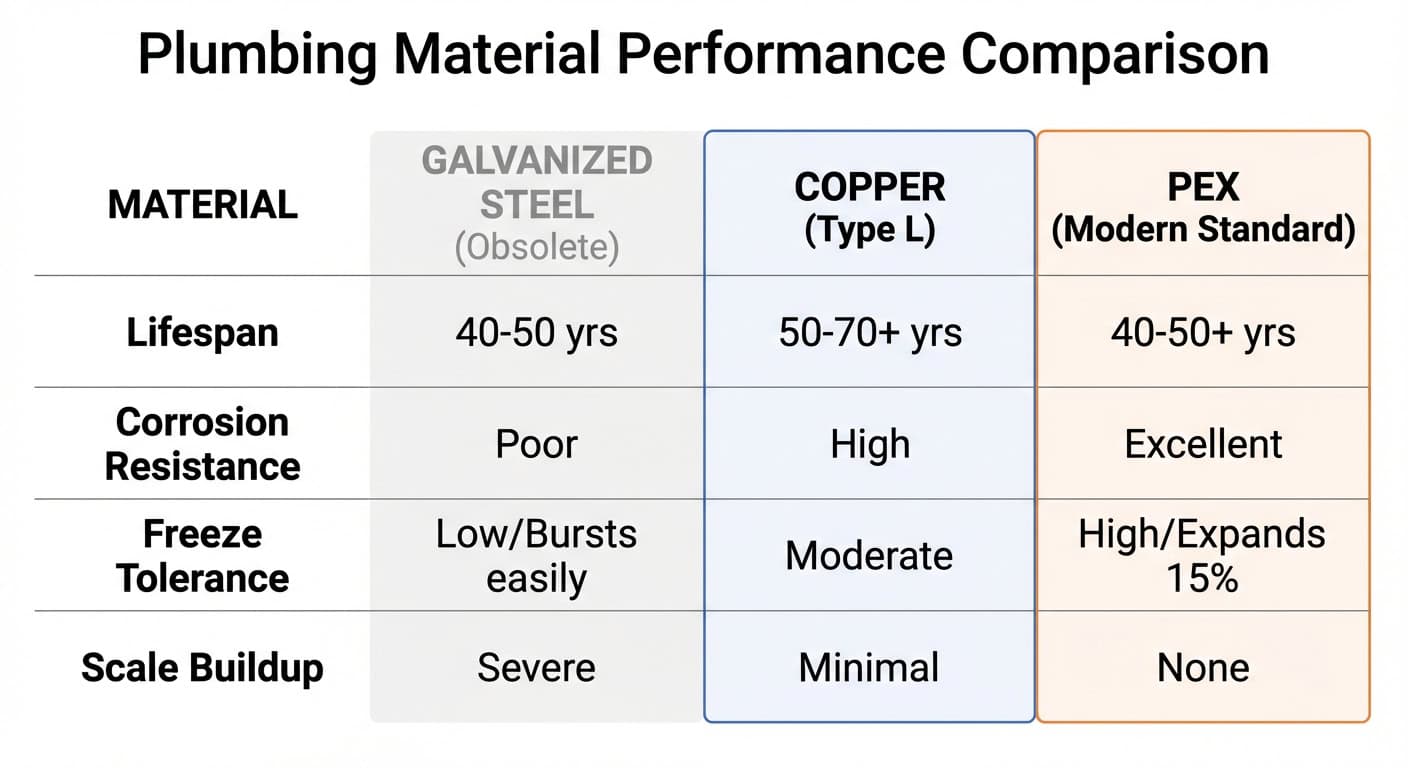
Upgrading to modern materials isn’t just about avoiding failure—it’s about improving water quality, pressure, energy efficiency, and home value. When it comes to replacing galvanized plumbing, homeowners have two primary options: copper (the traditional replacement) and PEX (the modern solution). Understanding the performance characteristics of each helps you make the best choice for your home and budget.
Copper Piping: The Traditional Standard
Copper has a proven track record spanning over 70 years. It’s durable, naturally antimicrobial, and maintains excellent water pressure. Type L copper (the thicker-walled residential grade) can last 50-70+ years under normal conditions. Copper is ideal for exposed pipes where aesthetics matter, and it’s the preferred choice for exterior hose bibs and areas requiring rigid connections. However, copper installation is labor-intensive, requiring soldering at every joint, and it’s susceptible to pinhole leaks in acidic water conditions.
PEX Piping: The Modern Solution
PEX has emerged as the dominant choice for whole-home repiping, particularly in the Pacific Northwest. Here’s why: Freeze Resilience: PEX can expand up to 15% without rupturing, making it ideal for our region’s occasional deep freezes. While copper and galvanized steel burst when water inside freezes, PEX flexes and recovers without damage. Thermal Efficiency: PEX has significantly lower thermal conductivity than copper, meaning hot water loses less heat as it travels from your water heater to fixtures. This translates to energy savings and faster hot water delivery. Installation Advantages: PEX is flexible and can be run in long continuous sections with fewer joints. Fewer joints means fewer potential leak points and faster installation, which typically translates to lower labor costs. Corrosion Immunity: Unlike metal pipes, PEX is completely immune to internal corrosion and scale buildup. The smooth interior surface maintains consistent flow capacity indefinitely. Water Quality: PEX doesn’t leach metals into water and doesn’t support bacterial growth on its smooth interior surfaces.
| Feature | Galvanized Steel | Copper | PEX |
|---|---|---|---|
| Lifespan | 40-50 years | 50-70+ years | 50-100+ years |
| Corrosion Risk | High | Moderate | None |
| Freeze Resistance | Poor (bursts) | Poor (bursts) | Excellent (flexible) |
| Health Concerns | Lead contamination | None (antimicrobial) | None |
| Installation Cost | N/A (obsolete) | High (labor-intensive) | Moderate (faster) |
The return on investment for repiping extends beyond just avoiding catastrophic failure. Market analysis shows that modern plumbing can increase a home’s resale value by 4-6%. During real estate transactions, updated plumbing is a major selling point that can eliminate buyer concerns and financing hurdles. Many real estate contracts now include specific contingencies requiring plumbing inspections, and galvanized pipes often trigger renegotiation or deal cancellations. Beyond financial considerations, the quality-of-life improvements are immediate and noticeable: consistent water pressure throughout the house, faster hot water delivery, clean water without rust discoloration, and the peace of mind that comes from knowing your plumbing won’t fail at the worst possible moment.
Final Thoughts
If you own a pre-1980 home in Vancouver or Portland, the question isn’t whether your galvanized pipes will fail—it’s when. The combination of the Pacific Northwest’s soft water, the natural expiration of these materials, and the increasing insurance industry pushback makes this a critical issue that demands immediate attention. The evidence is clear:
- Galvanized pipes were never designed to last beyond 50 years, and most PNW homes are well past that threshold
- Internal corrosion reduces water pressure while creating health risks through lead contamination and bacterial growth
- Soft PNW water accelerates decay, making regional homes more vulnerable than national averages
- Insurance companies are denying coverage and claims, leaving homeowners financially exposed
- Modern materials like PEX and copper provide long-term solutions with superior performance, safety, and resale value
The cost of inaction far exceeds the investment in proactive replacement. A burst pipe doesn’t just mean water damage—it means uninsurable losses, potential health hazards, and the disruption of replacing your plumbing under emergency conditions rather than on your timeline. Don’t wait for a catastrophic failure to force your hand. If you’re experiencing low water pressure, discolored water, or you simply don’t know when your plumbing was last updated, it’s time to schedule a comprehensive inspection.
Ready to Protect Your Home?
Contact Sarkinen Plumbing for a thorough plumbing assessment. Our team specializes in whole-home repiping throughout the Vancouver-Portland metro area, and we’ll help you transition to a safe, reliable, modern plumbing system.
References:
- U.S. General Services Administration (GSA). (2023). Plumbing Systems: Useful Life and Maintenance. https://www.gsa.gov/real-estate/historic-preservation/historic-preservation-policy-tools/preservation-tools-resources/technical-procedures
- United States Environmental Protection Agency (EPA). (2023). Sources of Lead in Drinking Water. https://www.epa.gov/ground-water-and-drinking-water/basic-information-about-lead-drinking-water
- The Hartford Steam Boiler Inspection and Insurance Company. (2022). The Hidden Risk of Galvanized Piping. https://www.munichre.com/hsb/en/services/engineering-and-inspection/equipment-care/plumbing-and-piping.html
- National Center for Biotechnology Information (NCBI). (2020). Biofilms in Drinking Water Distribution Systems. https://www.ncbi.nlm.nih.gov/pmc/articles/PMC7158309/
- U.S. Geological Survey (USGS). (2019). Water Hardness and Alkalinity. https://www.usgs.gov/special-topics/water-science-school/science/hardness-water
- Washington State Department of Health. (2022). Lead in Drinking Water. https://doh.wa.gov/community-and-environment/drinking-water/contaminants/lead
- NACE International (Association for Materials Protection and Performance). (2021). Galvanic Corrosion Fundamentals. https://www.nace.org/resources/general-resources/corrosion-basics/group-1/galvanic-corrosion
- Citizens Property Insurance Corporation. (2023). 4-Point Inspection Requirements. https://www.citizensfla.com/inspection-requirements
- National Association of Insurance Commissioners (NAIC). (2023). A Consumer’s Guide to Home Insurance. https://content.naic.org/sites/default/files/publication-mo-guide-home-insurance.pdf
- Plastics Pipe Institute. (2022). Design Guide: Residential PEX Water Supply Plumbing Systems. https://plasticpipe.org/common/Uploaded%20files/1-PPI/Publications/Design%20Guides/Residential-PEX-Water-Supply-Plumbing-Systems-Second-Edition.pdf
- The City of Portland Water Bureau. (2023). How to Identify Your Water Pipes. https://www.portland.gov/water/water-quality/lead/check-your-plumbing
- Insurance Information Institute (III). (2023). Water Damage: Covered or Not? https://www.iii.org/article/water-damage-covered-or-not
- U.S. Census Bureau. (2022). American Community Survey: Selected Housing Characteristics, Portland-Vancouver-Hillsboro Metro Area. https://data.census.gov/table/ACSDP1Y2022.DP04
- National Association of Realtors (NAR). (2022). Remodeling Impact Report. https://www.nar.realtor/research-and-statistics/research-reports/remodeling-impact
- Vancouver 360-369-3586
- Portland 503-925-3504




Vancouver Location
Proudly Serving
Portland and Vancouver
from Wilsonville to Longview &
Hillsboro to Gresham
UBI # 602-521-027
OR Contractor Lic# 170052 (CCB)
WA Contractor Lic# SARKIPI946MF
OR Plumber Lic# PB115
Customer Satisfaction
4.6 stars - Based on 227 Reviews







Quick Links
Plumbing Services
SW Washington Service Areas
Oregon Service Areas
Contact Information
Sarkinen PlumbingVancouver
9502 NE 72nd Ave
Vancouver, WA 98665
Phone: 360-369-3586
Portland
Phone: 503-925-3504
Hours of Operation
Monday - Sunday 24-hours