- Vancouver 360-369-3586
- Portland 503-925-3504

Trenchless Sewer Repair vs. Traditional Excavation: Saving Your PNW Landscaping
by writer | May 12, 2026
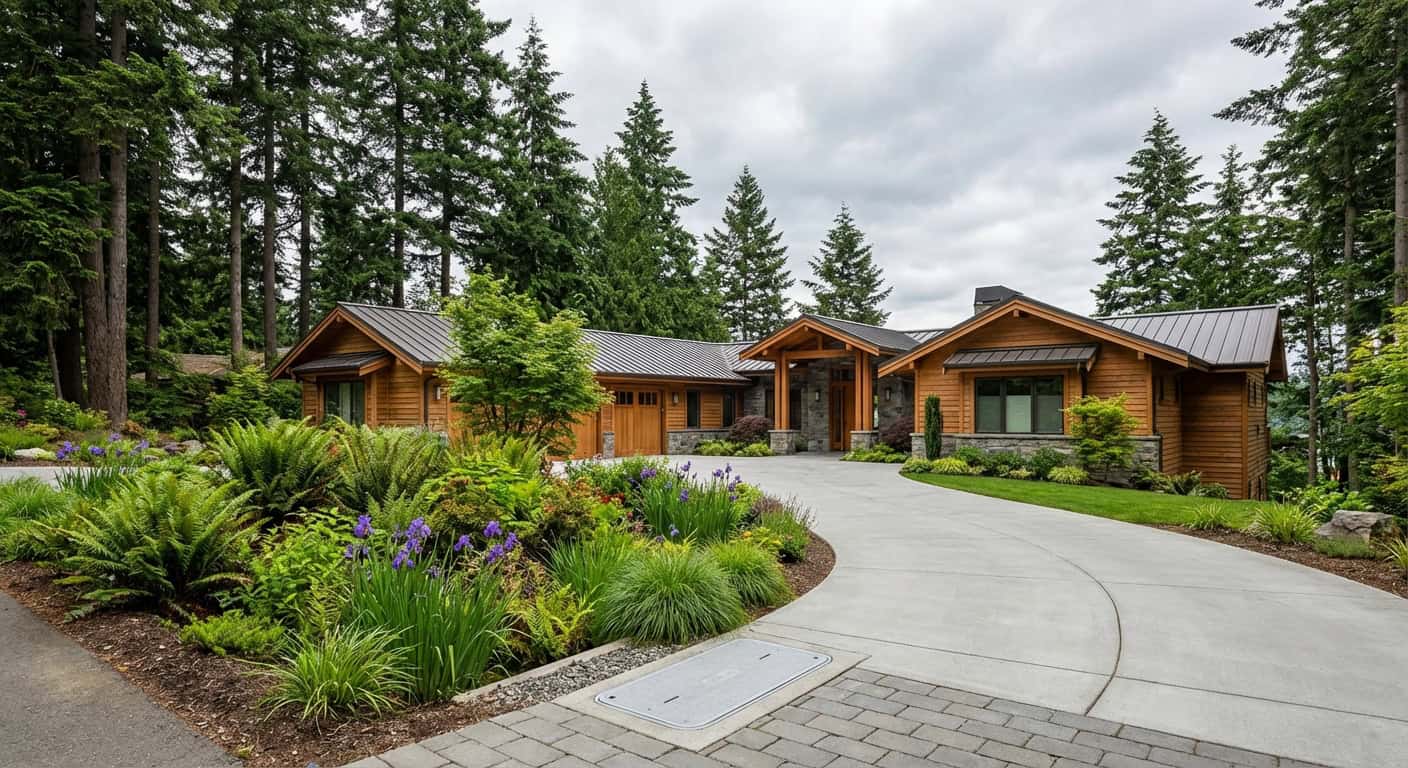
Table of Contents
- What Is Trenchless Sewer Repair? (And Why PNW Homeowners Need It)
- What They Don’t Tell You About Traditional Excavation: The Hidden Costs
- Protecting the Pacific Northwest’s Ecosystem, One Sewer Line at a Time
- The Numbers Don’t Lie: A Data-Driven Comparison
- How Portland Homeowners Are Saving Their Properties (And the Planet)
- Final Thoughts
Pacific Northwest homeowners invest thousands in their outdoor spaces—mature trees, custom rain gardens, eco-friendly bioswales, and beautiful hardscaping. But what happens when an aging sewer line fails beneath all that carefully cultivated landscaping? Traditionally, fixing a collapsed sewer meant hiring an excavation crew to dig a massive trench across your property, destroying driveways, patios, and irreplaceable vegetation in the process. For homeowners in Portland and Vancouver, where rainfall and aggressive tree roots accelerate pipe deterioration, this scenario is all too common. Fortunately, modern trenchless technology—including pipe bursting, directional boring, and Cured-in-Place Pipe (CIPP) lining—offers a minimally invasive alternative. According to the North American Society for Trenchless Technology, these methods can reduce surface disruption by over 90% while completing repairs in a fraction of the time. In this comprehensive guide, we’ll break down the science behind trenchless repair, compare it head-to-head with traditional excavation, and reveal why preserving your PNW landscaping isn’t just about aesthetics—it’s about protecting your property value and the environment.
What Is Trenchless Sewer Repair? (And Why PNW Homeowners Need It)
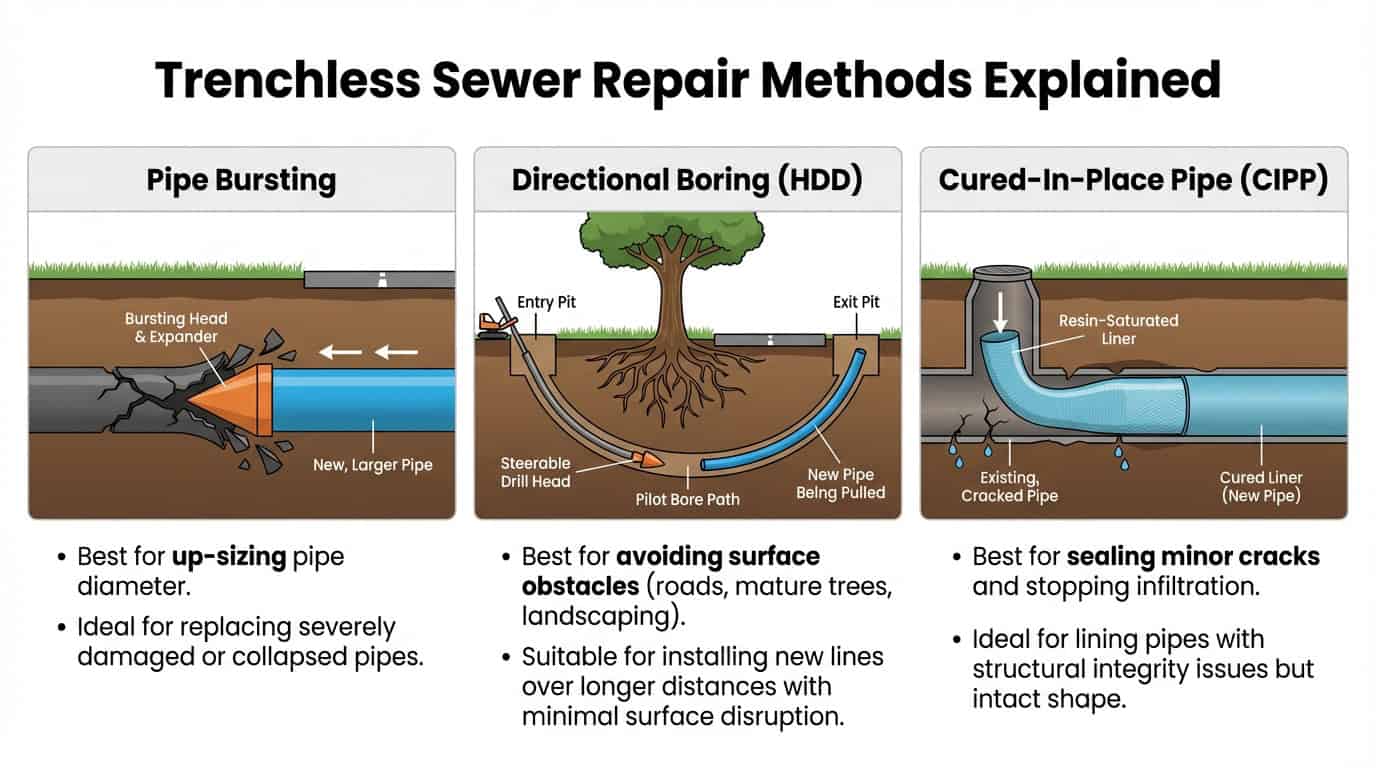
Modern trenchless technology represents a fundamental shift in how we approach underground infrastructure repair. Rather than excavating your entire yard, these innovative methods work beneath the surface with minimal disruption. Here’s how each technique protects your property while delivering superior results.
Pipe Bursting: The Complete Replacement Solution
Pipe bursting is a destructive trenchless method that completely replaces your failing sewer line without the destruction of traditional excavation. The process uses a hydraulic bursting head that’s pulled through the old pipe, fracturing the deteriorating clay, cast iron, or PVC outward into the surrounding soil. As the old pipe is destroyed, a new seamless High-Density Polyethylene (HDPE) pipe is simultaneously pulled into place. This method offers several critical advantages for PNW homeowners. First, it allows for diameter upsizing, which means if your current pipe is undersized for your home’s needs, we can install a larger replacement without additional excavation. Second, the seamless HDPE pipes have a documented lifespan of 50 to 100 years—far exceeding traditional materials. Most importantly for our region, these pipes eliminate the vulnerable joints that tree roots exploit to invade sewer lines.
Directional Boring: Creating New Pathways
When the original pipe route must be abandoned due to structural conflicts—perhaps a mature Douglas Fir has grown directly over the line, or a new addition has been built above the old pathway—directional boring (also called Horizontal Directional Drilling or HDD) provides the solution. This technique creates an entirely new underground path by drilling pilot holes beneath obstacles like driveways, mature trees, and rain gardens. The precision of modern boring equipment allows us to navigate around your property’s most valuable features without disturbing them. For PNW homeowners who’ve spent years cultivating specific landscapes, this technology is invaluable.
CIPP Lining: The Minimally Invasive Rehabilitation
Cured-in-Place Pipe lining represents the least invasive option in the trenchless toolkit. This method inserts a flexible, resin-saturated liner into your existing pipe through a single access point—typically your cleanout. Once positioned, the liner is cured using heat or UV light, creating a “pipe within a pipe” that seals cracks and prevents future deterioration. CIPP is particularly effective for addressing minor cracks and preventing root intrusion before it becomes a major problem. While it doesn’t completely replace the pipe like bursting does, it extends the life of your existing infrastructure by decades at a fraction of the cost and disruption.
The Pacific Northwest Advantage
These technologies aren’t just about convenience—they’re specifically suited to address our region’s unique challenges. Douglas Firs and Bigleaf Maples, iconic trees of the Pacific Northwest, have aggressive, water-seeking root systems that frequently invade traditional clay and cast iron sewer lines. The seamless HDPE pipes used in trenchless repair are impervious to root penetration, eliminating a problem that plagues traditional pipe materials in our tree-dense neighborhoods.
What They Don’t Tell You About Traditional Excavation: The Hidden Costs
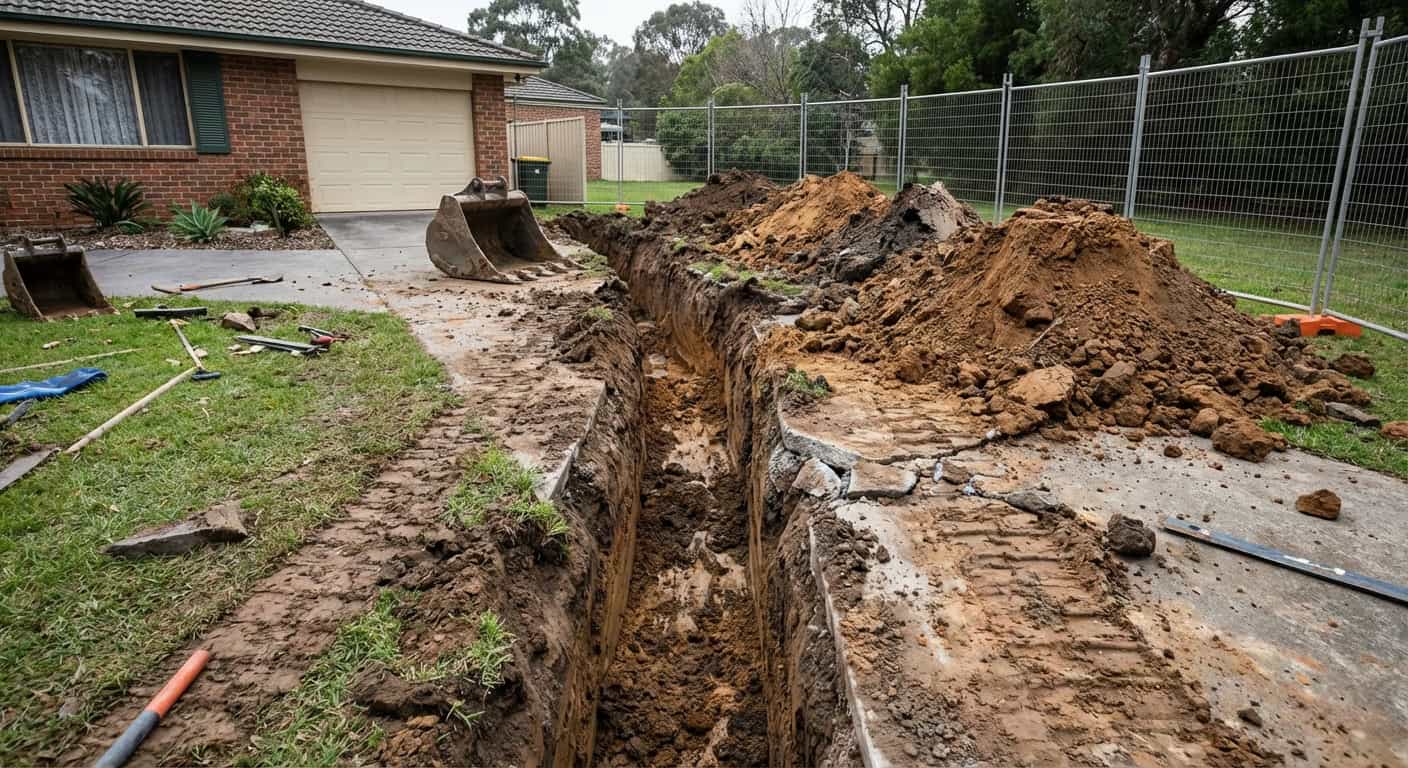
When you receive an initial quote for traditional excavation, you’re seeing only a fraction of the true cost. The plumber’s invoice might look straightforward, but what happens after the pipes are replaced tells a different story—one that can add 20% to 40% to your total project expenses.
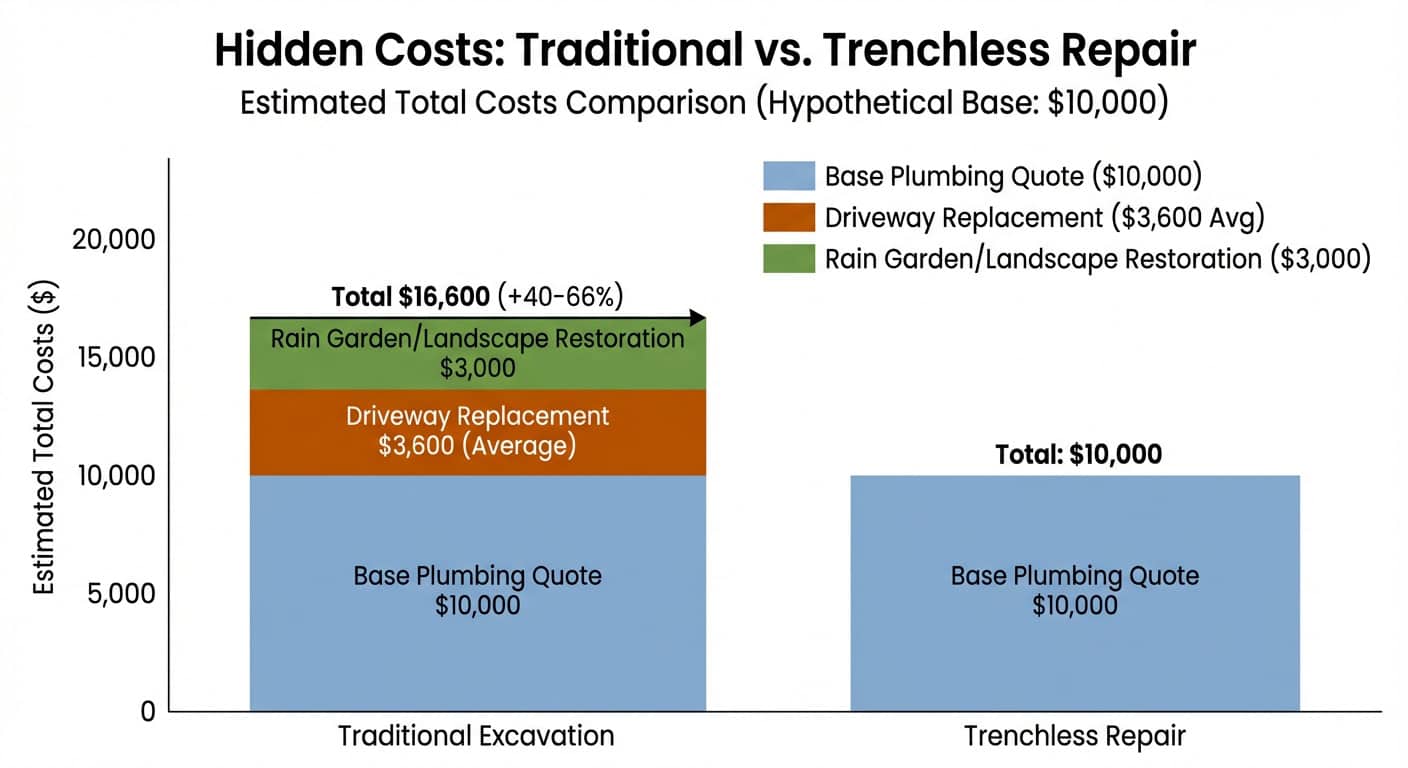
Understanding the complete financial impact helps explain why homeowners consistently choose trenchless solutions once they understand the full scope of traditional excavation.
Landscape and Hardscape Destruction
Open-cut trenching requires digging a continuous trench 3-6 feet deep across your property, following the entire path of your sewer line. Every flower bed, shrub, tree, and patch of carefully maintained lawn in that path gets destroyed. The American Society of Civil Engineers found that indirect costs—including landscape restoration, hardscape replacement, and environmental mitigation—add 20% to 40% to total project expenses. But it’s not just about replanting grass. The excavation process removes the structural integrity of your soil, requiring extensive backfilling and compaction to prevent future settling. Your yard won’t just need new sod—it needs engineered restoration to prevent sinkholes and drainage problems for years to come.
Driveway Replacement: The $5,000 Surprise
If your sewer line runs under your driveway—and most do—traditional excavation means cutting through it. In the Portland and Vancouver area, rebuilding a standard driveway costs an average of $6 to $12 per square foot. For a typical 20-foot section of driveway, you’re looking at $2,400 to $4,800 in asphalt or concrete costs alone, not including demolition and removal of the old material. Worse, a patched driveway rarely matches the original perfectly. Color differences in concrete and asphalt are nearly impossible to avoid, and the seams between old and new sections create weak points where water can penetrate and cause further damage during our wet PNW winters.
Rain Garden Restoration: Reconstructing Ecosystems
Portland and Vancouver actively encourage rain gardens for stormwater management, and many homeowners have invested significantly in these engineered ecosystems. These installations use precise grading and specialized soil mixtures designed to filter stormwater runoff while supporting deep-rooted native plants. Excavation doesn’t just damage rain gardens—it destroys them. The carefully engineered soil structure, the precise grading that ensures proper water flow, and the native plantings that took years to establish all get demolished. Reconstructing a rain garden can cost upward of $3,000, depending on size and complexity. More importantly, it takes years for the ecosystem to mature again and function at its original efficiency.
Retaining Walls and Mature Trees: Irreplaceable Losses
When excavation compromises the soil supporting a retaining wall, the entire structure can fail, requiring complete reconstruction that costs tens of thousands of dollars. Similarly, digging near mature trees often severs critical root systems. You can’t replace a 40-year-old Douglas Fir or Japanese Maple—these are irreplaceable property assets that add significant value to your home.
The Timeline Tax
Traditional excavation takes 3 to 7 days on average, during which your yard becomes a construction zone. You’ll endure extended noise from heavy machinery, deal with debris and mud tracked across your property, and lose access to portions of your yard entirely. For homeowners who work from home or have young children, this extended disruption has its own cost in lost productivity and stress.
Protecting the Pacific Northwest’s Ecosystem, One Sewer Line at a Time
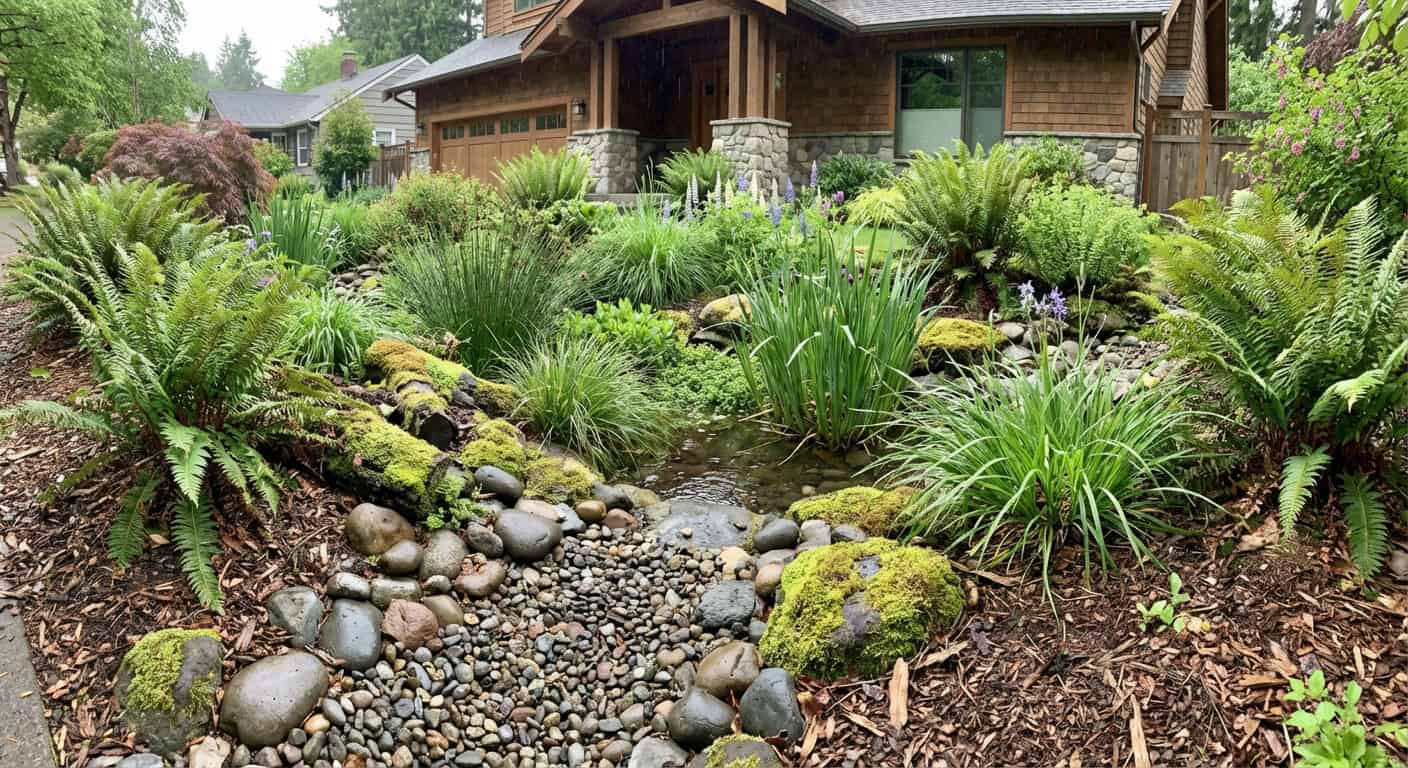
For eco-conscious Pacific Northwest homeowners, the environmental impact of home repairs matters. Trenchless technology isn’t just convenient—it’s the sustainable choice that aligns with our region’s environmental values.
Slashing Carbon Emissions by 75%
Traditional excavation requires heavy diesel machinery running for days—excavators, dump trucks, compactors, and more. Each piece of equipment burns fossil fuels and emits greenhouse gases throughout the project. A comprehensive life-cycle assessment study published by the EPA found that trenchless pipe replacement reduces greenhouse gas emissions by up to 75% compared to traditional open-cut methods. This dramatic reduction comes from eliminating the need for heavy earth-moving equipment and the transportation of excavated soil to landfills. With trenchless methods, minimal equipment is required, and it runs for a fraction of the time, drastically reducing your project’s carbon footprint.
Eliminating Soil Waste
Open-cut excavation generates literal tons of excavated soil that must be transported away from your property. In urban areas like Portland and Vancouver, this soil typically goes to landfills, consuming valuable landfill space and requiring multiple truck trips that add to traffic congestion and emissions. Trenchless methods require only 1-2 small access pits, drastically reducing waste. The soil that is removed can often be reused for backfilling these minimal access points, creating a nearly zero-waste repair process.
Preserving Bioswales and Rain Gardens
The City of Portland’s Bureau of Environmental Services emphasizes that rain gardens are engineered ecosystems designed to filter stormwater runoff and protect local waterways from pollution. These systems took careful planning to design and years to establish. They represent a homeowner’s investment in environmental stewardship and community water quality.
“Excavation destroys the precise soil structure and native plantings that make these systems function. The engineered soil layers—designed to filter pollutants while allowing proper drainage—get mixed and contaminated. The deep-rooted native plants that filter water and prevent erosion get ripped out.”
Trenchless boring operates entirely beneath these systems, preserving their ecological function completely. Your rain garden continues filtering stormwater and supporting native pollinators without interruption, maintaining its environmental benefits and aesthetic value.
Weather Independence in the Pacific Northwest
Our region’s notorious rainfall makes traditional excavation particularly problematic. Open trenches fill with water, creating muddy, hazardous job sites. Rain delays extend project timelines, and wet conditions make proper soil compaction nearly impossible, leading to long-term settling problems. Trenchless work is largely weather-independent. Since the repair happens underground through minimal access points, rain doesn’t flood the work area or create the muddy chaos associated with open trenching. This means your project can proceed on schedule, regardless of our famously unpredictable weather.
The Numbers Don’t Lie: A Data-Driven Comparison
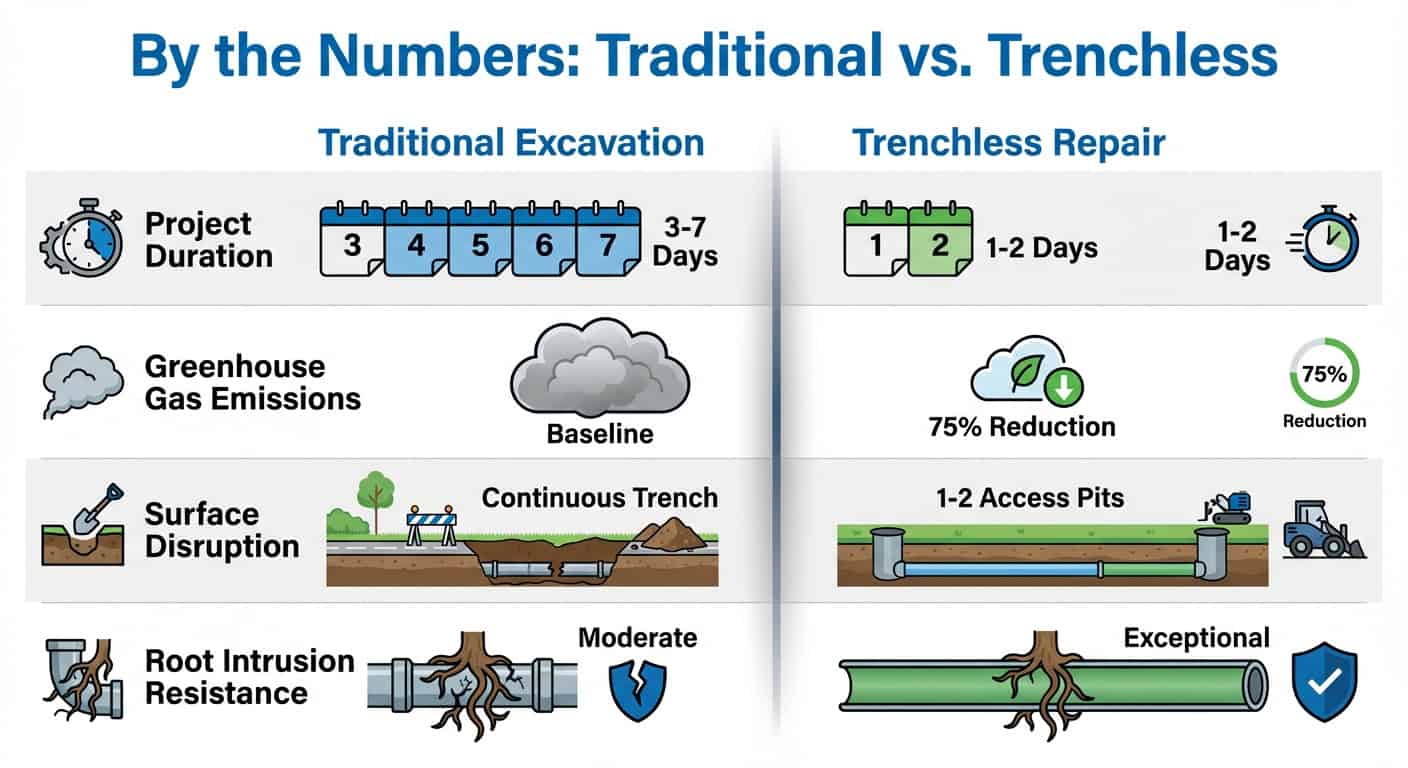
When you compare trenchless and traditional excavation methods across every meaningful metric, the advantages of modern technology become undeniable. Let’s examine the data that’s driving over 80% of municipalities and private contractors to shift toward trenchless methods.
Surface Disruption: Minimal vs. Catastrophic
Traditional excavation creates a continuous trench across your property, often 3-6 feet deep and several feet wide, following the entire path of your sewer line. Every inch of that trench represents destroyed landscaping, disrupted soil structure, and restoration work. Trenchless methods require only 1-2 small access pits—typically at the beginning and end points of the repair. The rest of your property remains completely undisturbed. This dramatic difference in surface disruption is the primary driver behind the cost savings and environmental benefits of trenchless technology.
Project Duration: Days vs. Weeks
Traditional excavation projects typically take 3 to 7 days to complete, not including restoration work. When you factor in the time needed to repair driveways, restore landscaping, and allow new concrete to cure, the total timeline can extend to weeks. Trenchless repairs typically complete in 1 to 2 days. Your sewer system is back online faster, the disruption to your household is minimized, and you can return to normal life almost immediately. For homeowners who can’t afford extended disruption, this timeline difference is critical.
Root Intrusion Resistance: Vulnerable vs. Impervious
Traditional repair methods often use joined pipes made from PVC, clay, or cast iron. Each joint represents a potential entry point for water-seeking tree roots. In the Pacific Northwest, where trees are abundant and rainfall keeps soil moist, roots aggressively seek out these weak points. The seamless HDPE pipes used in trenchless pipe bursting eliminate this vulnerability entirely. With no joints to exploit, roots cannot penetrate the pipe. This fundamental difference means trenchless repairs last decades longer in our tree-rich environment, avoiding the repeat failures that plague traditional repairs.
Municipal and Market Adoption
The shift toward trenchless technology isn’t just happening in residential settings. Over 80% of municipalities and private contractors now prefer trenchless methods for underground pipeline rehabilitation due to reduced social costs—including noise, traffic disruption, and property damage. The global trenchless pipe rehabilitation market was valued at USD 6.2 billion in 2023 and is projected to grow at a compound annual growth rate of 6.8% through 2030. This explosive growth reflects widespread recognition that trenchless technology isn’t just an alternative—it’s the superior method for modern infrastructure repair.
Key Takeaway
When you consider surface disruption, project duration, restoration costs, environmental impact, and long-term durability together, trenchless technology delivers superior results across every category that matters to homeowners. The initial investment in trenchless repair often costs less than traditional excavation once restoration expenses are factored in, and the long-term value is incomparably better.
How Portland Homeowners Are Saving Their Properties (And the Planet)
Real-world application proves the value of trenchless technology better than any theoretical discussion. From municipal infrastructure projects to individual residential repairs, the results speak for themselves.
Municipal Success in Portland
The City of Portland has faced ongoing challenges with aging sewer infrastructure, much of which was originally installed over 80 years ago. To combat root intrusion from the city’s heavy urban canopy without destroying historic streets and residential retaining walls, local environmental bureaus have aggressively adopted CIPP and pipe bursting technologies. A municipal study of sewer rehabilitation projects showed dramatic results. By utilizing trenchless methods, project timelines were reduced by 60%, and neighborhood complaints regarding construction noise and property damage dropped to near zero. The city avoided the social costs of extended street closures, business disruptions, and the destruction of mature street trees that define Portland’s character.
Residential Application: Saving a Custom Rain Garden
Consider a real-world scenario facing many Vancouver homeowners: A family had invested $8,000 in a custom rain garden featuring native plants, engineered soil, and a beautiful Japanese Maple as a centerpiece. When their sewer line collapsed directly beneath this installation, traditional excavation would have meant complete destruction of their environmental investment. Instead, Sarkinen Plumbing used directional boring to route a new HDPE pipe beneath the rain garden. The job took two days, required only two small access points at either end of the property, and left the rain garden completely untouched. The family saved their landscaping investment, avoided weeks of reconstruction, and received a superior pipe with a 50-100 year lifespan—all for a comparable cost to traditional excavation once restoration expenses were factored in.
Long-Term Value: An Investment That Outlasts Traditional Repairs
Trenchless repair isn’t just about avoiding immediate destruction—it’s an investment in infrastructure that will outlast traditional repairs by decades. While traditional joined pipes typically last 20-30 years before requiring replacement, the seamless HDPE pipes installed through trenchless methods are documented to last 50 to 100 years. This longevity means homeowners who choose trenchless repair today are likely making their last sewer line investment. Their children may inherit the home without ever needing to address the sewer line—a stark contrast to the repeat failures common with traditional materials in our root-heavy, wet PNW environment.
Scaling Municipal Technology to Residential Properties
At Sarkinen Plumbing, we’ve brought commercial-grade technology to residential properties across Vancouver, WA, and the Portland metro area. The same pipe bursting and directional boring techniques that cities use to rehabilitate miles of infrastructure work equally well for individual homeowners—and deliver the same benefits of minimal disruption, superior durability, and environmental responsibility.
Final Thoughts
When your sewer line fails, the choice between traditional excavation and trenchless repair isn’t just about fixing a pipe—it’s about protecting your property investment, preserving the Pacific Northwest’s unique environmental landscape, and choosing a sustainable, future-proof solution. The data is clear: trenchless technology reduces project timelines by 60%, eliminates restoration costs that can exceed $10,000, and cuts greenhouse gas emissions by 75%. For PNW homeowners who’ve spent years cultivating rain gardens, preserving mature trees, and investing in eco-friendly landscaping, the decision is simple. At Sarkinen Plumbing, we’ve seen firsthand how trenchless repair transforms what could be a homeowner’s worst nightmare into a streamlined, stress-free experience. Our team specializes in pipe bursting, directional boring, and CIPP lining—bringing municipal-grade technology to residential properties across Vancouver, WA, and the Portland metro area. Understanding the total project cost matters. While the upfront quote for traditional excavation might sometimes appear comparable to trenchless repair, the hidden expenses of driveway replacement, landscape restoration, and rain garden reconstruction make traditional methods significantly more expensive. More importantly, trenchless technology delivers a superior result that protects your property and lasts generations.
Ready to Protect Your Property?
Don’t let outdated excavation methods destroy your landscaping investment. Contact Sarkinen Plumbing today for a free consultation and discover how trenchless technology can save your yard—and thousands of dollars.
References:
- North American Society for Trenchless Technology (NASTT). (2024). What is Trenchless Technology? https://nastt.org/trenchless-technology/
- Plastics Pipe Institute. (2023). HDPE Pipe Life Expectancy and Trenchless Applications. https://plasticpipe.org/BuildingConstruction/BuildingConstruction/Water-Pipe-Materials/HDPE.aspx
- American Society of Civil Engineers (ASCE). (2021). Economic and Environmental Impact of Trenchless Technology vs. Open-Cut. https://ascelibrary.org/doi/10.1061/9780784413692.012
- City of Portland, Bureau of Environmental Services. (2024). Rain Gardens and Stormwater Management. https://www.portland.gov/bes/stormwater/rain-gardens
- U.S. Environmental Protection Agency (EPA). (2018). State of Technology for Rehabilitation of Wastewater Collection Systems. https://nepis.epa.gov/Exe/ZyPDF.cgi/P100A0YQ.PDF?Dockey=P100A0YQ.PDF
- Grand View Research. (2023). Trenchless Pipe Rehabilitation Market Size, Share & Trends Analysis Report. https://www.grandviewresearch.com/industry-analysis/trenchless-pipe-rehabilitation-market
- Trenchless Technology Magazine. (2022). Overcoming Urban Infrastructure Challenges With Pipe Bursting. https://trenchlesstechnology.com/overcoming-urban-infrastructure-challenges-pipe-bursting/
- Vancouver 360-369-3586
- Portland 503-925-3504




Vancouver Location
Proudly Serving
Portland and Vancouver
from Wilsonville to Longview &
Hillsboro to Gresham
UBI # 602-521-027
OR Contractor Lic# 170052 (CCB)
WA Contractor Lic# SARKIPI946MF
OR Plumber Lic# PB115
Customer Satisfaction
4.6 stars - Based on 227 Reviews







Quick Links
Plumbing Services
SW Washington Service Areas
Oregon Service Areas
Contact Information
Sarkinen PlumbingVancouver
9502 NE 72nd Ave
Vancouver, WA 98665
Phone: 360-369-3586
Portland
Phone: 503-925-3504
Hours of Operation
Monday - Sunday 24-hours