- Vancouver 360-369-3586
- Portland 503-925-3504

Longview Chemical Spill: How to Ensure Your Home’s Tap Water is Safe
by writer | Jun 05, 2026
Table of Contents
- The Hidden Journey: From Industrial Tank to Your Tap
- The Limitations of Standard Water Treatment During Chemical Emergencies
- Which Water Filtration Technology Actually Removes Industrial Chemicals?
- When Municipal Systems Failed, Home Filtration Succeeded
- 5 Steps to Ensure Your Family’s Water Safety Today
- Final Thoughts
The recent chemical tank rupture at industrial facilities in Longview, Washington has raised urgent questions for homeowners throughout Southwest Washington: Is my tap water safe? What happens when industrial chemicals enter the Columbia River? And most importantly, what can I do to protect my family? While municipal water systems have treatment protocols in place, the reality is that traditional treatment facilities weren’t designed to handle sudden spikes in industrial chemical contamination. According to the EPA’s Columbia River Basin Toxics Reduction program, over 100 toxic contaminants have historically been introduced into our region’s waterways from industrial and agricultural runoff. When you consider that nearly 50% of stream and river water comes from groundwater discharge, it becomes clear that surface spills can directly impact the aquifers supplying our homes. For residents of Vancouver, Ridgefield, Camas, and surrounding communities who rely on the Columbia River aquifer, understanding your water quality risks and available protection options isn’t just about peace of mind—it’s about safeguarding your family’s health. This guide provides the technical knowledge and actionable solutions you need to ensure your tap water remains safe, regardless of what’s happening upstream.
The Hidden Journey: From Industrial Tank to Your Tap
Before you can protect your water, you need to understand how contamination travels from industrial sites through SW Washington’s unique hydrogeology to potentially reach your home. The Columbia River Basin operates as an interconnected surface water and groundwater system, creating a vulnerability that many homeowners don’t fully appreciate. When surface water becomes contaminated, the pollution doesn’t stay on the surface—it seeps into the soil and eventually reaches the underground aquifers that feed our wells and municipal water intakes. According to the U.S. Geological Survey, nearly 50% of the water flowing in our streams and rivers originates from groundwater discharge, meaning surface spills inevitably impact subterranean water tables.
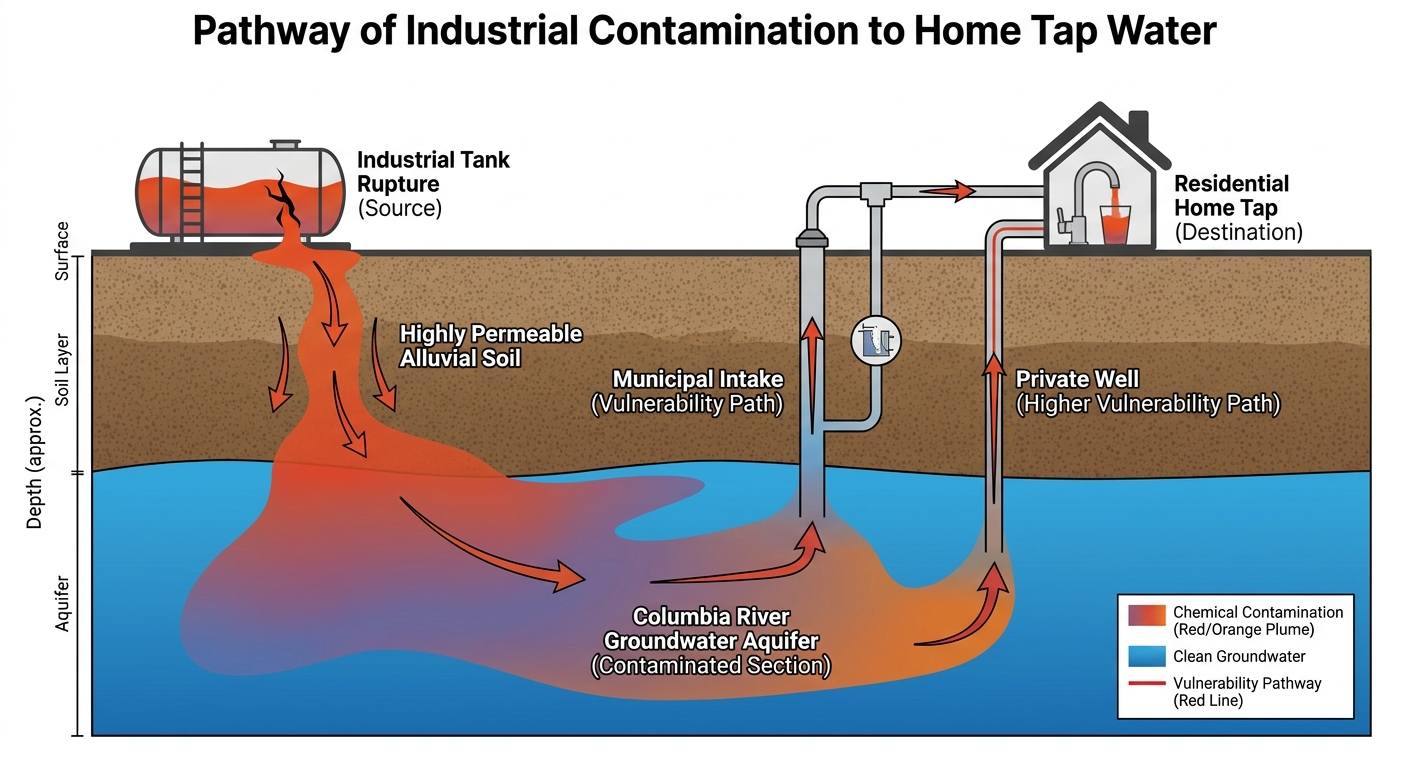
Industrial mills in Longview use massive quantities of chemicals in their daily operations, including chlorine dioxide, sodium hypochlorite (bleach), caustic soda, and various volatile organic compounds (VOCs). When a tank rupture occurs, these substances can escape containment and begin their journey toward residential water supplies. What makes Southwest Washington particularly vulnerable is our region’s highly permeable alluvial soil deposits. Unlike areas with dense clay or bedrock that slow contamination, our sandy, gravelly soils allow chemical plumes to seep into aquifers more quickly than in other regions. This geological reality means that contaminants can reach water supplies before natural attenuation has time to break them down. The EPA’s Columbia River Basin Toxics Reduction program has identified over 100 known toxic contaminants from various industrial sources in our watershed. These aren’t just theoretical risks—they represent real chemical compounds that have been detected in our regional water systems over time. Municipal water intakes can be compromised before natural processes filter out these contaminants, especially during emergency spill scenarios when concentrations spike suddenly. For the approximately 15% of Washington state residents who rely on private wells, the situation is even more precarious. Private wells aren’t regulated by the EPA’s Safe Drinking Water Act, meaning there’s no governmental oversight ensuring your water meets safety standards—that responsibility falls entirely on you as the homeowner.
The Limitations of Standard Water Treatment During Chemical Emergencies
Municipal water treatment plants excel at removing biological threats and common particulates, but they weren’t engineered for sudden industrial chemical surges. Understanding this limitation is crucial for making informed decisions about your home’s water protection. Traditional municipal treatment focuses on three primary goals: removing sediment through filtration, killing bacteria and viruses through chlorination, and adjusting pH levels for corrosion control. These processes work exceptionally well for their intended purposes—preventing waterborne diseases like cholera, typhoid, and dysentery that plagued communities a century ago. However, complex industrial solvents, volatile organic compounds, and synthetic chemicals require entirely different treatment approaches. Municipal facilities use standard sand filtration and basic activated carbon, which can handle low-level, consistent contamination but struggle when faced with sudden spikes in industrial chemical concentrations.
The Environmental Working Group’s national tap water database reveals a sobering reality: many treatment facilities struggle to completely remove industrial VOCs and PFAS compounds without advanced carbon filtration specifically designed for chemical removal. Consider what happened during the 2014 Elk River chemical spill in West Virginia. When 10,000 gallons of MCHM (a coal-washing chemical) leaked into the Elk River just upstream from the municipal intake, the treatment plant’s standard filtration system was completely overwhelmed. The result? 300,000 residents were left without safe tap water for weeks. Municipal workers scrambled to increase treatment intensity, but the chemical concentration was simply too high for their existing infrastructure to handle effectively. This case study isn’t meant to criticize municipal water operators—they work diligently within the systems they have. Rather, it illustrates a fundamental engineering reality: municipal treatment plants are optimized for routine conditions, not emergency contamination events. According to the Water Quality Association’s 2023 survey, over 50% of Americans express concern about tap water quality, driving a 12% year-over-year increase in residential water treatment installations. This trend reflects a growing understanding among homeowners that municipal treatment, while essential and generally effective, may not provide complete protection during industrial emergencies. Even treated municipal water can contain trace amounts of industrial chemicals that accumulate over time in the human body. While individual exposures may fall below EPA maximums, chronic low-level exposure to multiple contaminants raises concerns about cumulative health effects that aren’t fully captured in existing regulations.
Which Water Filtration Technology Actually Removes Industrial Chemicals?
Not all water filters are created equal. Understanding the scientific mechanisms behind different filtration technologies is essential for choosing effective protection against industrial contamination.
Activated Carbon Filtration
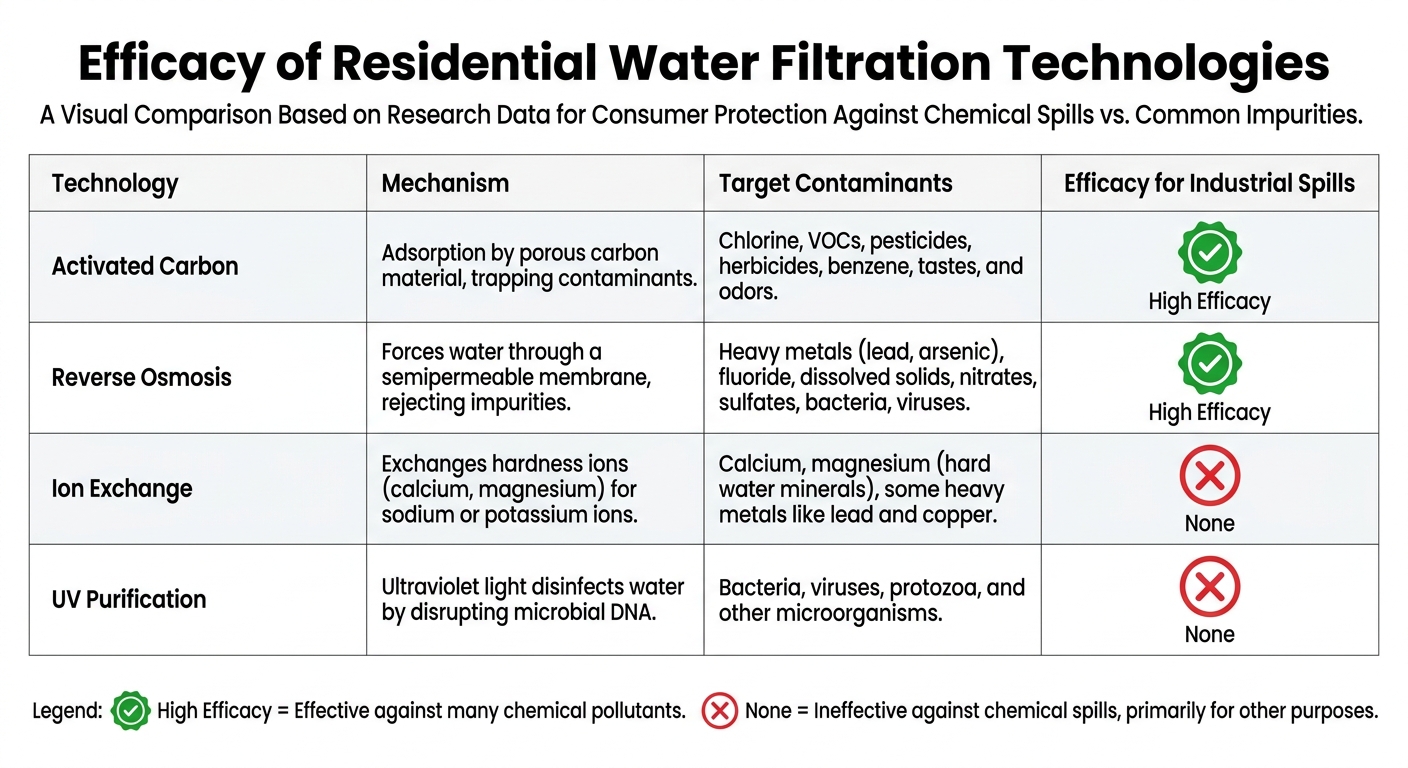
Activated carbon works through a process called adsorption, where industrial chemicals physically bind to the highly porous surface of specially treated carbon. Think of it like a molecular sponge—as water passes through the carbon media, contaminants stick to the massive surface area created by millions of microscopic pores. This technology is highly effective for removing:
- Volatile organic compounds (VOCs)
- Chlorine derivatives
- Chemical solvents
- Unpleasant tastes and odors
However, not all carbon filters are equal; look for systems meeting NSF/ANSI 42 and 53 certifications, which verify performance against specific contaminants.
Reverse Osmosis (RO)
Reverse Osmosis represents the gold standard for removing complex industrial chemicals. This technology forces water through a semi-permeable membrane at high pressure, physically straining out contaminants at the molecular level. The membrane’s tiny pores (typically 0.0001 microns) are small enough to block:
- Heavy metals like lead and arsenic
- PFAS compounds
- Dissolved solids
- Even fluoride
RO systems require NSF/ANSI 58 certification to ensure they meet rigorous performance standards. While RO systems do produce some wastewater during the filtration process, modern units have become significantly more efficient, and the health benefits far outweigh this consideration.
Ion Exchange (Water Softeners)
Ion Exchange deserves special attention because of a widespread misconception. Many homeowners mistakenly believe their water softener protects against chemical contamination—it absolutely does not. Ion exchange systems work by swapping hardness minerals (calcium and magnesium) for sodium ions, addressing scale buildup and soap scum but providing zero protection against industrial chemicals or VOCs. If you have a water softener, you still need dedicated chemical filtration.
UV Purification
UV Purification uses ultraviolet light to kill bacteria and viruses by disrupting their DNA, making them unable to reproduce. While highly effective for biological threats, UV systems provide absolutely no protection against chemical contamination. UV light passes through water containing dissolved chemicals without altering them in any way. These systems are useful as part of a multi-stage treatment approach, particularly for private well owners concerned about bacterial contamination, but they must be combined with chemical filtration for comprehensive protection.
Point-of-Entry vs. Point-of-Use Systems
The distinction between Point-of-Entry (POE) and Point-of-Use (POU) systems is also critical:
| System Type | Coverage | Best For |
|---|---|---|
| Point-of-Entry (POE) | Treats all water entering your house | Protecting every faucet, shower, and appliance from contaminants |
| Point-of-Use (POU) | Installed at a single outlet (typically under-sink) | Providing ultra-pure water for drinking and cooking |
Whole-home POE systems ensure you’re not exposed to contaminants through skin absorption during bathing or through steam inhalation.
NSF International certification standards ensure filtration systems meet rigorous testing protocols. When shopping for water filtration, always verify NSF certification rather than relying on manufacturer claims alone. These independent laboratory tests confirm that systems actually remove the contaminants they claim to address.
When Municipal Systems Failed, Home Filtration Succeeded
Historical precedents demonstrate that household filtration systems provide critical protection when municipal treatment is overwhelmed. The most instructive case study comes from the 2014 Elk River disaster in West Virginia.
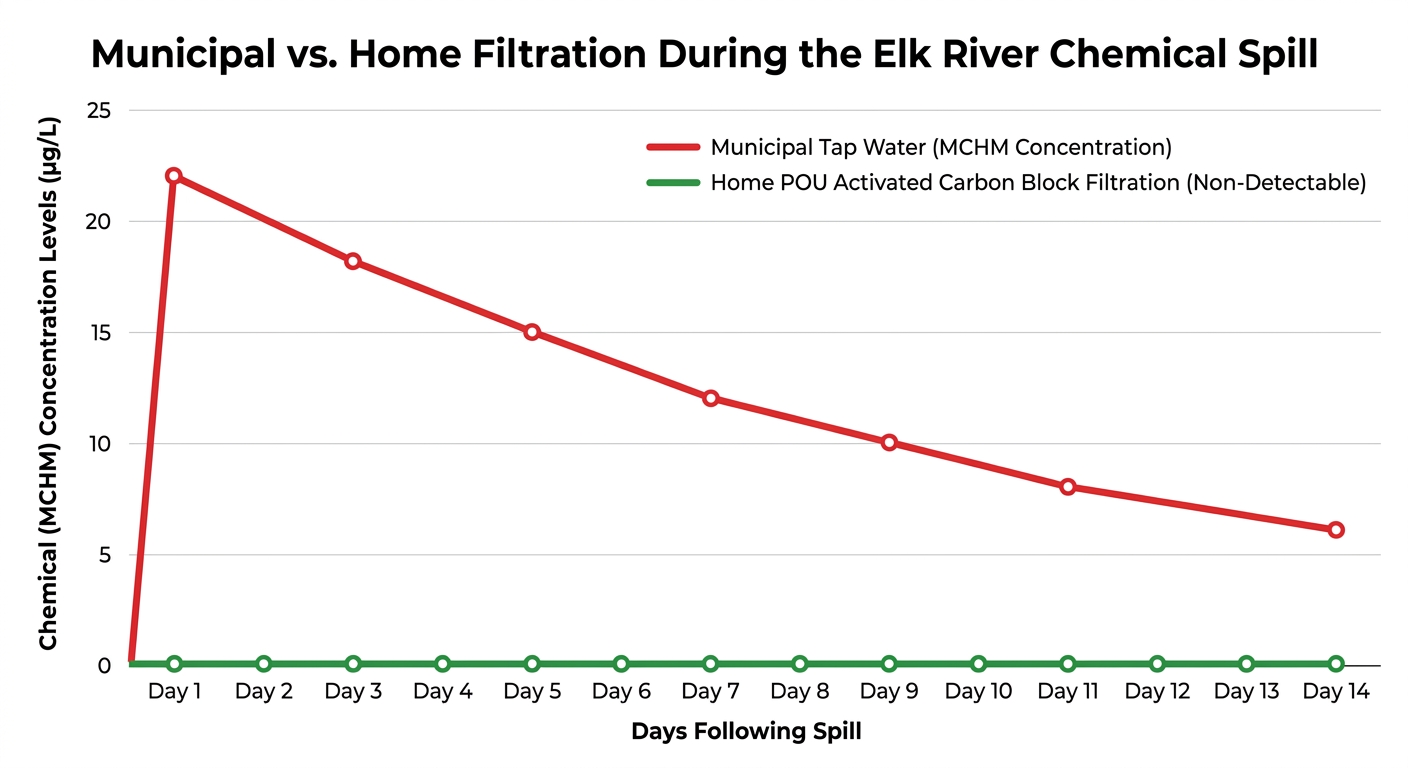
On January 9, 2014, approximately 10,000 gallons of MCHM (4-methylcyclohexanemethanol), a chemical foam used in coal washing, leaked from a storage tank into West Virginia’s Elk River. The spill occurred just 1.5 miles upstream from the municipal water intake serving Charleston and surrounding communities. Within hours, residents began reporting a strong licorice odor coming from their taps, and authorities issued a water-use ban affecting 300,000 people. The municipal treatment plant tried to increase filtration and add additional treatment chemicals, but the MCHM concentration overwhelmed their standard sand and basic carbon filtration systems. Residents were told not to drink, cook with, bathe in, or even wash clothes with tap water. The ban lasted nine days for most residents, and some areas remained under advisory for weeks. Here’s where the story becomes directly relevant for SW Washington homeowners: post-spill laboratory testing conducted by researchers showed that residential activated carbon block filters successfully reduced MCHM to non-detectable levels, even when municipal treatment failed. Homes that had pre-installed, NSF-certified point-of-use filtration systems maintained safe drinking water throughout the crisis while neighbors scrambled for bottled water.
“Residential POU filters successfully reduced MCHM to non-detectable levels in residential tests.”
This wasn’t theoretical—it was real-world evidence that household filtration technology, properly installed and maintained, can protect families when centralized systems reach their limits.
Bringing It Home: Columbia River Basin Risks
The Columbia River Basin isn’t free from industrial contamination risks—in fact, the Washington State Department of Ecology actively manages ongoing industrial cleanup sites throughout our region. Historic operations in Longview have required extensive groundwater remediation to prevent aquifer contamination, and these cleanup efforts continue today. The Department of Ecology’s cleanup site database reveals multiple locations along the Columbia River corridor where industrial activities have required soil and groundwater remediation. These aren’t distant, historical problems—they’re active management situations requiring ongoing monitoring and treatment. While these cleanup efforts are essential and professionally managed, they underscore an important reality: industrial chemical threats are not one-time events. They represent ongoing risk requiring proactive home protection. The combination of ongoing industrial activity, our region’s permeable geology, and the interconnected nature of surface water and groundwater means that SW Washington homeowners face real contamination risks. The Elk River disaster proved that when crisis strikes, homeowners with pre-installed, certified filtration systems maintain safe drinking water while those relying solely on municipal treatment face potentially dangerous exposure.
5 Steps to Ensure Your Family’s Water Safety Today
Translating technical knowledge into immediate, practical actions is essential. Here’s your comprehensive action plan for protecting your family’s water supply.
Step 1: Get Independent Water Testing
Don’t rely solely on annual municipal reports—they show historical averages, not current conditions. Professional water testing provides a detailed snapshot of what’s actually coming out of your tap right now. A comprehensive test should analyze:
- Volatile organic compounds (VOCs)
- Heavy metals (particularly lead and arsenic)
- PFAS compounds
- pH levels
- Total dissolved solids
- Hardness minerals
For private well owners, quarterly testing is recommended, especially after storm events or known industrial incidents. Heavy rainfall can accelerate contaminant movement through soil into aquifers, while industrial spills obviously create immediate risk. Even municipal water customers benefit from independent testing, as it reveals what’s actually reaching your home after traveling through aging distribution pipes. Sarkinen Plumbing offers comprehensive water quality testing that goes beyond basic municipal screening. Our testing provides detailed analysis and actionable recommendations specific to your home’s water chemistry and your family’s needs.
Step 2: Evaluate Your Current System
Many homeowners mistakenly believe their water softener provides chemical protection—it doesn’t. Take inventory of any existing water treatment equipment in your home. If you have a water softener, understand that it only addresses hardness minerals and provides zero protection against industrial chemicals or VOCs.
Check filter replacement dates carefully. Saturated carbon filters and aging RO membranes lose effectiveness dramatically. If you can’t remember when you last changed filters, it’s almost certainly time for replacement. Many homeowners install filtration systems and then neglect maintenance, essentially negating the investment.
Step 3: Choose Certified Filtration Technology
For industrial chemical protection, prioritize systems with NSF/ANSI 53 (activated carbon) and NSF/ANSI 58 (reverse osmosis) certifications. These aren’t marketing badges—they’re independently verified performance standards confirming that systems actually remove specific contaminants. The hybrid approach provides optimal protection: whole-home carbon filtration combined with under-sink RO for drinking and cooking water. The whole-home system removes chlorine, VOCs, and larger particulates throughout your house, protecting you from skin absorption during bathing and inhalation exposure from steam. The under-sink RO system provides ultra-pure water for drinking, cooking, and food preparation. Ensure installation by licensed professionals familiar with local water chemistry. Proper installation matters enormously—incorrectly installed systems can actually introduce contamination or fail to provide expected protection. Sarkinen Plumbing’s technicians understand SW Washington’s unique water challenges and can recommend systems specifically matched to local conditions.
Step 4: Establish Maintenance Schedules
Water filtration systems require ongoing maintenance to remain effective.
| Component | Replacement Frequency | Why It Matters |
|---|---|---|
| Carbon Filters | Every 6-12 months | Saturated carbon loses adsorption capacity |
| RO Membranes | Every 2-3 years | Degraded membranes allow contaminants through |
| Pre/Post Filters | Quarterly | Protects RO membrane and provides final polishing |
Schedule professional maintenance rather than relying on memory. Sarkinen Plumbing offers maintenance programs that ensure your system receives timely filter changes and performance verification, giving you continuous protection without the hassle of tracking replacement schedules.
Step 5: Stay Informed on Local Water Quality
Active awareness helps you respond quickly to emerging threats. Action items:
- Monitor Washington State Department of Ecology cleanup site updates for new developments affecting Columbia River water quality
- Sign up for municipal water quality alerts—most utilities now offer email or text notifications when issues arise
- Join local community water quality forums and neighborhood groups
- Keep emergency contact information readily available
Neighbors often share real-time observations about taste, odor, or discoloration issues before official notices are issued. This community intelligence can provide early warning that prompts testing or activates emergency protocols.
Final Thoughts
The recent Longview chemical spill serves as a stark reminder that industrial activity along the Columbia River poses real risks to SW Washington’s water supply. While our municipal water systems provide essential baseline treatment, they weren’t designed to handle sudden surges of industrial chemicals that can overwhelm standard filtration processes. The evidence is clear: residential water filtration systems provide a critical safety net when municipal treatment reaches its limitations. The Elk River disaster demonstrated that homeowners with certified carbon and reverse osmosis systems maintained safe drinking water while 300,000 neighbors went without. With over 100 known toxic contaminants in the Columbia River Basin and ongoing industrial cleanup sites in our region, proactive protection isn’t optional—it’s essential. The good news? Modern filtration technology is more effective and affordable than ever. Whether you’re on municipal water or a private well, the right combination of certified filtration systems can remove the industrial chemicals, heavy metals, and VOCs that threaten your family’s health. Your water quality directly impacts your family’s health, from the water you drink to the showers you take and the meals you prepare. Don’t wait for the next spill to think about protecting what matters most.
Ready to ensure your family’s water safety?
Contact Sarkinen Plumbing today for professional water testing and a customized filtration consultation. Our team understands SW Washington’s unique water challenges and can design a protection system specifically matched to your home’s needs.
Call 360-369-3586 Schedule Consultation
Your family’s health is worth the investment.
References:
- U.S. Geological Survey (USGS). (1998). Ground Water and Surface Water: A Single Resource. U.S. Geological Survey Circular 1139. https://pubs.usgs.gov/circ/circ1139/
- U.S. Environmental Protection Agency (EPA). (2023). Columbia River Basin Toxics Reduction. https://www.epa.gov/columbiariver
- Environmental Working Group (EWG). (2023). EWG’s Tap Water Database: Washington. https://www.ewg.org/tapwater/
- Water Quality Association (WQA). (2023). Consumer Opinion Study. https://wqa.org/wqa-consumer-opinion-study/
- Washington State Department of Health. (2024). Private Wells: Information for Homeowners. https://doh.wa.gov/community-and-environment/drinking-water/drinking-water-emergencies/private-wells
- NSF International. (2024). Water Filter Standards and Certifications. https://www.nsf.org/consumer-resources/water-quality/water-filters-testing-treatment
- National Institutes of Health (NIH) / PubMed Central. (2016). Residential Tap Water Contamination Following the Freedom Industries Chemical Spill: Perceptions, Water Quality, and Health Impacts. https://www.ncbi.nlm.nih.gov/pmc/articles/PMC5123533/
- Washington State Department of Ecology. (2024). Contamination Cleanup Sites: Columbia River Basin. https://ecology.wa.gov/Spills-Cleanup/Contamination-cleanup/Cleanup-sites
- Vancouver 360-369-3586
- Portland 503-925-3504




Vancouver Location
Proudly Serving
Portland and Vancouver
from Wilsonville to Longview &
Hillsboro to Gresham
UBI # 602-521-027
OR Contractor Lic# 170052 (CCB)
WA Contractor Lic# SARKIPI946MF
OR Plumber Lic# PB115
Customer Satisfaction
4.6 stars - Based on 227 Reviews





Quick Links
Plumbing Services
SW Washington Service Areas
Oregon Service Areas
Contact Information
Sarkinen PlumbingVancouver
9502 NE 72nd Ave
Vancouver, WA 98665
Phone: 360-369-3586
Portland
Phone: 503-925-3504
Hours of Operation
Monday - Sunday 24-hours