- Vancouver 360-369-3586
- Portland 503-925-3504


The PNW Homeowner’s Guide to Sump Pump Diagnostics and Preventative Maintenance
by writer | Apr 14, 2026
Table of Contents
- Understanding the Unique Flooding Risks in the Portland-Vancouver Metropolitan Area
- Why a $200 Inspection Beats a $25,000 Flood Cleanup: The Financial Case for Preventative Maintenance
- The 15-Minute Pre-Season Sump Pump Test That Could Save Your Home
- The Sounds and Symptoms of a Failing Sump Pump: When to Call Sarkinen Plumbing
- Why Every PNW Home Needs a Backup Sump Pump System: Battery vs. Water-Powered Options
- Sarkinen’s Seasonal Maintenance Checklist: Your Year-Round Protection Plan
- Final Thoughts
Picture this: You wake up on a Saturday morning in November after a fierce overnight storm. As you shuffle to the kitchen for coffee, you hear an ominous sound—water trickling where it shouldn’t be. Your heart sinks as you open the basement door to find three inches of standing water slowly destroying boxes of family photos, holiday decorations, and the finished living space you worked so hard to create. Your sump pump, the silent guardian of your home’s foundation, has failed at the worst possible moment.
For homeowners in the Portland and Vancouver metropolitan areas, this nightmare scenario isn’t just theoretical—it’s a statistical probability without proper preventative maintenance. The Pacific Northwest’s unique climate creates the perfect storm of flooding risk factors. According to the National Weather Service, our region receives between 36 and 43 inches of annual rainfall, with a staggering 75% occurring between October and March. When “Pineapple Express” atmospheric rivers sweep through, they can dump several inches of rain within 48 hours, rapidly overwhelming drainage systems and placing tremendous pressure on your home’s sump pump.
The financial stakes couldn’t be higher. FEMA estimates that just one inch of water in your basement can cause up to $25,000 in property damage—and that’s before you factor in mold remediation, structural repairs, and the irreplaceable loss of sentimental belongings. Yet most of this devastation is entirely preventable through proper sump pump diagnostics and maintenance.
This comprehensive guide will equip you with actionable diagnostic protocols, help you recognize critical warning signs of pump failure, and provide a seasonal maintenance schedule proven to reduce flooding risk by 85%. Whether you’re a longtime homeowner or new to the region, understanding how to protect your home starts with understanding your sump pump. Let’s dive in.
Understanding the Unique Flooding Risks in the Portland-Vancouver Metropolitan Area
Before we explore diagnostics and maintenance, it’s essential to understand why sump pumps are absolutely critical infrastructure in the Pacific Northwest—and why ours face unique operational challenges compared to drier regions.
The PNW Climate Reality
Our regional weather patterns create a perfect confluence of flooding risk factors. While we don’t experience the intense, short-duration thunderstorms common in other parts of the country, our prolonged winter rainfall creates sustained hydrostatic pressure against home foundations. This constant pressure, combined with the region’s naturally high water tables, means your sump pump isn’t just dealing with occasional storm events—it’s working nearly continuously from October through March.
Atmospheric rivers represent the most acute threat. These massive corridors of moisture-laden air, often originating near Hawaii (hence the “Pineapple Express” nickname), can stall over the Portland-Vancouver area and deliver rainfall totals that would normally occur over weeks in just 48-72 hours. When this happens, even properly functioning drainage systems can be overwhelmed, placing your sump pump under maximum load at the exact moment when power outages from falling trees are most likely.
Urban Infrastructure Vulnerabilities
The Washington State Department of Ecology identifies sudden winter runoff and localized urban flooding as the leading causes of residential water damage in the lower Columbia River basin. As our cities have expanded, increased impervious surfaces like roads, parking lots, and buildings prevent rainfall from naturally absorbing into the ground. This runoff has to go somewhere—and that somewhere is often directly into residential drainage systems.
If your home was built in an area with a high water table (common throughout much of Vancouver and East Portland), your sump pit is essentially functioning as a collection point for groundwater that’s constantly trying to equalize with the surrounding soil saturation level. During peak rainy season, that water table can rise dramatically, meaning your pump may cycle dozens of times per day even without a major storm event.
The Age Factor: A Ticking Time Bomb
Here’s a sobering statistic from the International Association of Certified Home Inspectors: The average residential sump pump has a lifespan of just 7-10 years. Think about when your pump was installed. If you’ve been in your home for close to a decade and haven’t replaced your pump, you’re statistically approaching the end of its reliable operational period.
The problem is that pump failure rarely announces itself with dramatic warning signs until it’s too late. Instead, components degrade gradually—motor bearings wear down, float switches become less responsive, check valves begin to leak—until one day during a critical storm event, the pump simply doesn’t activate or cannot keep up with water influx.
The financial consequences of this failure are severe and well-documented. As FEMA’s data shows:
- 1 inch of standing water: $25,000+ in damages
- 6 inches of standing water: $40,000+ in damages
These aren’t worst-case scenarios—they’re average cost estimates that include drywall replacement, electrical system repairs, HVAC equipment damage, and the inevitable mold remediation that follows basement flooding.
Why a $200 Inspection Beats a $25,000 Flood Cleanup: The Financial Case for Preventative Maintenance
When it comes to home maintenance, few investments offer a more dramatic return on investment than sump pump care. The economics are remarkably straightforward, yet homeowners consistently underestimate the risk of neglect.
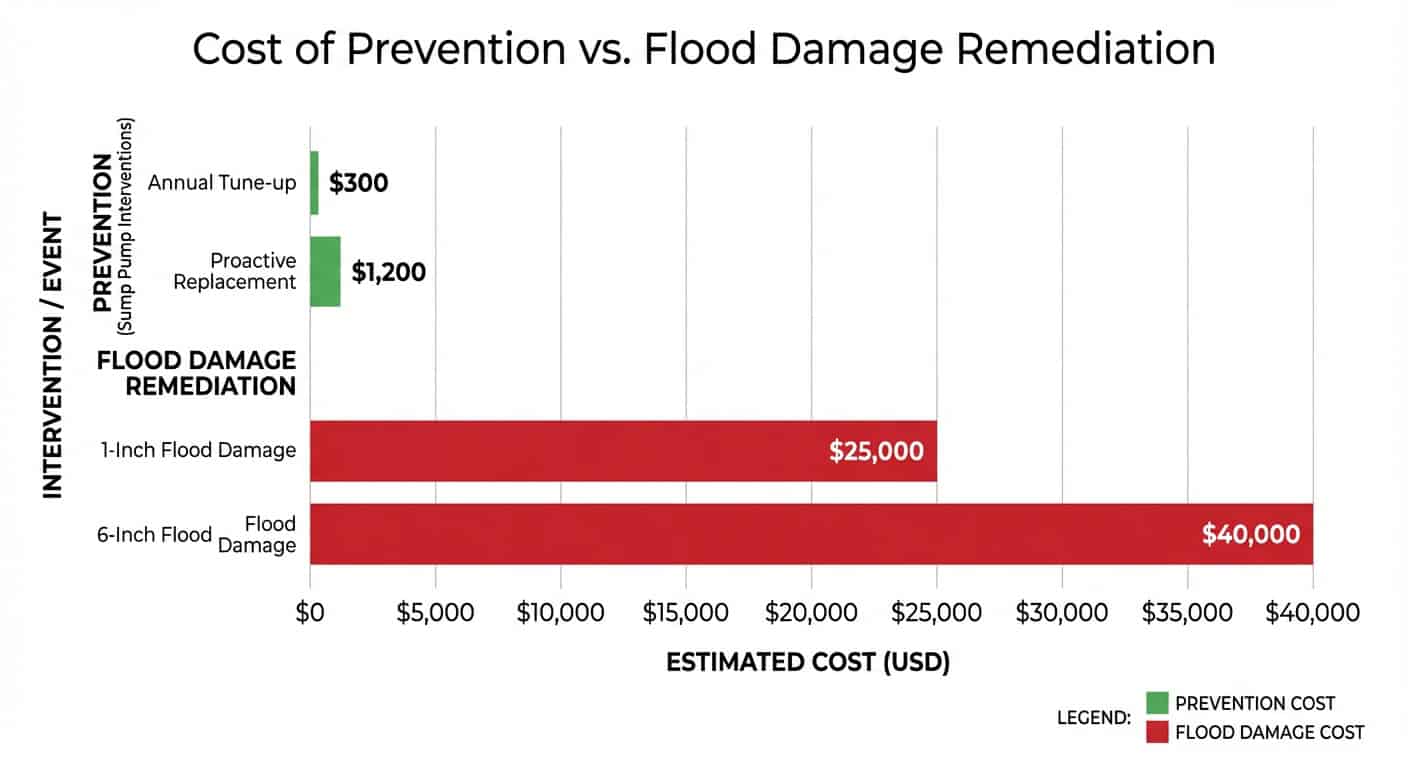
Let’s break down the real costs. An annual professional sump pump inspection typically runs between $150 and $300. During this service, a qualified plumber will test all components, clear the impeller of debris, verify proper float switch operation, inspect the check valve, and test your backup system if you have one. If your pump is approaching the end of its lifespan, a proactive replacement costs between $400 and $1,200 depending on pump capacity and installation complexity.
Now contrast these preventative costs with remediation expenses. That single inch of water FEMA warns about isn’t just wet carpet—it’s:
- Complete drywall removal and replacement (drywall is essentially ruined once it absorbs water)
- Electrical outlet and circuit replacement (water and electricity create serious safety hazards)
- HVAC system cleaning or replacement (ductwork can become contaminated)
- Mold remediation (which can easily run $5,000-$10,000 on its own)
- Flooring replacement
- Damaged furniture, appliances, and personal belongings
- Temporary living arrangements while repairs are completed
At six inches of flooding, you’re potentially looking at structural foundation concerns, complete electrical panel replacement, and total loss of basement-located appliances like water heaters, furnaces, and washers/dryers.
The “It Won’t Happen to Me” Fallacy
Human psychology works against us when it comes to preventative home maintenance. Because sump pumps typically operate out of sight in basements or crawlspaces, and because they often work reliably for years without intervention, homeowners develop a false sense of security. We fall prey to normalcy bias—the cognitive tendency to underestimate the likelihood of disaster because it hasn’t happened yet.
But the data tells a different story. Research from the University of Maryland’s Center for Disaster Resilience reveals that 60% of basement floods in homes equipped with sump pits are caused by power failures during storms, while an additional 30% result from mechanical pump failure due to age or lack of maintenance. Combined, these preventable causes account for 90% of basement flooding incidents.
Key Insight:
Homeowners who implemented bi-annual maintenance schedules and installed backup power systems reduced their flooding risk by 85%. That’s not a marginal improvement—that’s nearly eliminating the risk entirely through simple, affordable interventions.
The Lifespan Economics
Regular maintenance doesn’t just prevent catastrophic failure—it extends your pump’s operational lifespan beyond the 7-10 year average. A pump that receives annual professional inspection and cleaning can often remain reliable for 12-15 years, effectively doubling your return on investment. When you consider that a $300 annual service protects against $25,000+ in potential damages while also extending equipment life by 50%, the economics become undeniable.
The key insight is this: Sump pump failure isn’t a matter of “if” but “when.” The question isn’t whether your pump will eventually need replacement—it absolutely will. The question is whether that replacement happens on your schedule through planned maintenance, or during a November atmospheric river event when every plumber in the Portland-Vancouver area is responding to emergency flood calls.
The 15-Minute Pre-Season Sump Pump Test That Could Save Your Home
September and October represent the most critical window for sump pump testing in the Pacific Northwest. Before the October-through-March rainfall concentration begins, every homeowner should perform a simple but comprehensive diagnostic audit. This 15-minute investment could literally save your home.
The Bucket Test Protocol
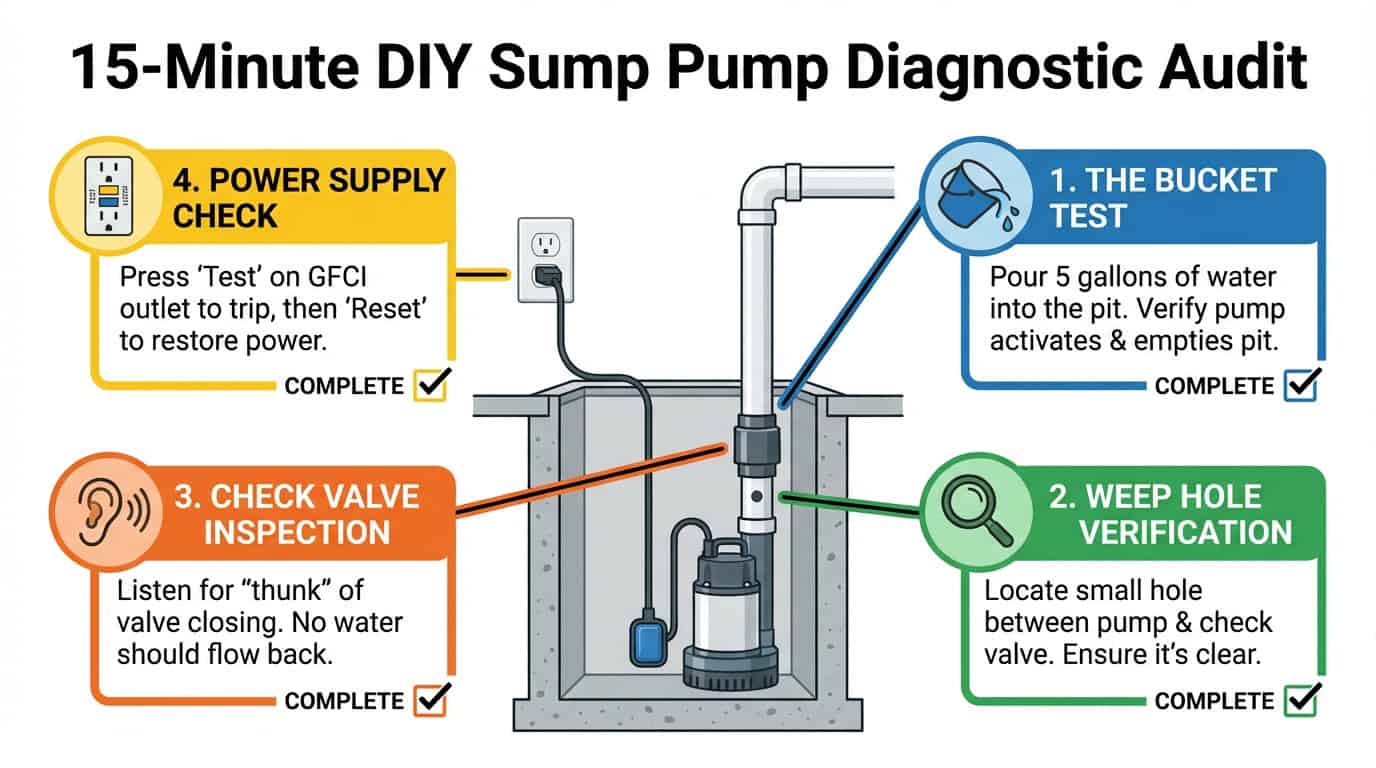
The cornerstone of sump pump diagnostics is what the North Dakota State University Extension calls “The Bucket Test.” This simple procedure validates every critical component of your pump system in one comprehensive check. Here’s exactly how to perform it:
- Prepare Your Test: Fill a five-gallon bucket with water. Use your garden hose or bathtub—the exact source doesn’t matter, but you need a full five gallons to properly simulate realistic operating conditions.
- Slowly Pour Water Into the Sump Pit: Don’t dump the water in all at once. Instead, pour it in at a moderate, steady rate. This simulates how water actually enters your pit during a rain event—gradually rather than instantaneously.
- Watch the Float Switch: As the water level rises, the float switch should trigger at a specific height (usually 8-12 inches depending on your pit depth). The pump should activate immediately—not after hesitation or delay. If there’s a lag of more than 2-3 seconds, your float switch may be degrading.
- Listen to the Motor: When the pump activates, listen carefully. You should hear a strong, consistent motor hum without any grinding, rattling, or clicking sounds. The pump should sound confident and powerful, not strained or labored.
- Observe the Discharge: Water should begin evacuating from the pit almost immediately. Watch your discharge line (the pipe that carries water away from your home). Water should flow smoothly and forcefully—not in weak spurts or trickles.
- Verify Complete Shut-Off: As the water level drops, the float switch should return to its resting position and the pump should shut off completely. Critically, the motor should stop running. If you hear the motor continuing to hum after the pump should have shut off, you have a serious problem—the motor is “dry running,” which rapidly causes overheating and permanent damage.
The Weep Hole Inspection
While your pump is running during the bucket test, locate the weep hole. This is a small hole (usually 1/8 to 1/4 inch in diameter) drilled in the discharge pipe between the pump and the check valve. Many homeowners don’t know it exists, but it serves a critical function.
The weep hole prevents airlock—a condition where air becomes trapped in the discharge line, preventing water movement despite the motor running. When water first enters the discharge pipe on pump activation, the weep hole allows trapped air to escape. Once water reaches the weep hole level, it creates a seal and the pump achieves full pressure.
Check your weep hole for clogs. Common culprits include mineral deposits, rust particles, and debris. If the hole is clogged, your pump may run without actually moving water, leading to motor burnout.
Check Valve Verification
After your pump completes its cycle and shuts off, listen carefully at the discharge pipe. You should hear silence. If instead you hear water rushing backward down the pipe, your check valve is failing.
The check valve (located in the discharge line above the pump) is a one-way valve that prevents discharged water from flowing back into the pit after the pump shuts off. A failing check valve creates a devastating cycle: The pump evacuates the pit, shuts off, the water flows back in, the pump activates again within seconds. This “short-cycling” can cause a pump to run dozens or even hundreds of times per day, dramatically shortening its lifespan and increasing the risk of failure during high-demand periods.
Power Supply and Electrical Verification
Before you finish your diagnostic, check these electrical components:
- GFCI Outlet Functionality: Sump pumps should be plugged into a GFCI (Ground Fault Circuit Interrupter) outlet for safety. Test the GFCI by pressing the “test” button—it should trip. Then press “reset” to restore power. If the GFCI won’t reset or doesn’t trip when tested, it needs replacement.
- Dedicated Circuit: Verify your pump is on its own dedicated circuit breaker, not sharing electrical capacity with other appliances. During high-demand periods, a shared circuit can trip, leaving your pump without power.
- Cord Condition: Inspect the power cord for fraying, cracks, or damage. Even minor damage can create electrical shorts, especially in the damp environment where sump pumps operate.
⚠️ Red Flags Requiring Immediate Professional Intervention
If your bucket test reveals any of these conditions, do not wait—contact Sarkinen Plumbing immediately:
- Pump fails to activate when water reaches the float switch level
- Water discharges slowly, weakly, or not at all despite motor running
- Grinding, rattling, or clicking sounds during operation
- Motor hums but no water movement occurs (jammed impeller)
- Pump runs continuously without shutting off
- Visible rust, corrosion, or structural damage to pump housing
- Pump is seven years or older (approaching end of average lifespan)
These aren’t minor maintenance issues—they’re indicators of imminent failure. Addressing them in September or October means scheduling a convenient service appointment. Ignoring them means risking a 2 AM emergency call during the worst storm of the year.
The Sounds and Symptoms of a Failing Sump Pump: When to Call Sarkinen Plumbing
Your sump pump communicates its condition through sounds and operational patterns. Learning to recognize these acoustic and mechanical warning signs allows you to intervene before failure occurs—transforming what could be an emergency flood situation into a routine service call.
Acoustic Warning Signs: What Your Pump is Telling You
Grinding or Rattling Noises: If your pump suddenly develops a grinding or rattling sound during operation, you’re hearing the sound of metal-on-metal contact that shouldn’t be happening. This typically indicates one of two problems: worn motor bearings or a damaged impeller (the rotating component that actually moves water). Both conditions accelerate rapidly once they begin. A grinding pump this week may be a seized pump next week.
Low Humming Without Water Movement: Perhaps the most deceptive failure mode is the pump that hums convincingly but doesn’t move any water. This usually indicates a jammed impeller—often caused by debris that’s worked its way past the intake screen—or a seized motor bearing. The danger here is two-fold: First, the pump isn’t actually protecting your home despite appearing to run. Second, a jammed motor quickly overheats, leading to electrical shorts or blown fuses that can affect other systems on the same circuit.
Clicking Sounds: Repetitive clicking often signals float switch problems. The float switch is a simple mechanical component, but it’s also a critical single point of failure. If the switch sticks in the “off” position, your pump never activates. If it sticks “on,” your pump runs continuously until something breaks. Clicking indicates the switch is struggling to make consistent contact, suggesting imminent failure.
Gurgling or Bubbling: These sounds typically indicate discharge line issues rather than pump problems, but they’re equally concerning. Gurgling often means the discharge line is partially blocked, forcing water to move past an obstruction. Bubbling can indicate improper venting or the beginnings of a discharge line freeze (particularly concerning as winter approaches). Both conditions reduce discharge efficiency, meaning your pump must work longer and harder to achieve the same water removal.
Mechanical and Operational Red Flags
Short-Cycling (Rapid On-Off Cycling): If your pump turns on and off every few minutes rather than running for 15-30 seconds and then remaining off for extended periods, you have a short-cycling problem. The most common causes are:
- Failing Check Valve: As discussed earlier, this allows water to flow back into the pit after discharge, creating a perpetual cycle.
- Improperly Sized Basin: If your sump pit is too small for the water influx rate in your area, the pump may cycle excessively even when functioning correctly. This is a design problem requiring basin enlargement.
- Float Switch Malfunction: A float switch that triggers at too low a water level causes excessive cycling.
Short-cycling is particularly destructive because pump motors aren’t designed for constant starting and stopping. Each start-up creates electrical and mechanical stress. A pump that cycles 100 times per day experiences dramatically more wear than one that runs ten longer cycles.
Excessive Vibration: All pumps vibrate slightly during operation—that’s normal. Excessive vibration that you can feel through the floor above or that causes the discharge pipe to shake is not normal. This usually indicates either failing motor mounts (the rubber feet or brackets that stabilize the pump) or an unbalanced impeller. Both conditions accelerate component wear and increase the risk of discharge line disconnection.
Continuous Operation: A pump that runs for several minutes without shutting off, or that runs constantly during dry periods when no water is entering the pit, signals a serious problem. Possible causes include a stuck float switch, massive water influx overwhelming pump capacity, or a discharge line blockage preventing effective water removal.
Visible Rust or Corrosion: Sump pumps operate in wet environments, but they shouldn’t rust extensively. Surface rust on the exterior housing may be cosmetic, but heavy rust, especially on the motor casing or around electrical connections, indicates the pump is beyond its serviceable life. Corrosion weakens metal components and creates electrical hazards.
Age as a Critical Risk Factor
Even if your pump currently shows no obvious symptoms, age alone is a warning sign. The International Association of Certified Home Inspectors’ 7-10 year average lifespan isn’t arbitrary—it’s based on documented failure rate data. Pumps in their final years often show subtle performance degradation before catastrophic failure: slightly longer activation delays, marginally reduced discharge pressure, occasional unusual sounds that then disappear.
The University of Maryland research on basement flooding is particularly illuminating here: 30% of basement floods result from mechanical pump failure due to age or inadequate maintenance. These aren’t random failures—they’re predictable outcomes of deferred maintenance.
The Pre-Storm Service Window
Here’s a critical operational insight: Once a major storm is forecasted, it’s often too late to schedule preventative service. When atmospheric rivers threaten the Portland-Vancouver area, plumbing companies are immediately overwhelmed with emergency calls from homeowners whose pumps have already failed or are showing distress under heavy load.
The time to address warning signs is now—during dry or moderate weather when service appointments are readily available and when your home isn’t under immediate flood threat. If you’ve noticed any of the symptoms described above, don’t convince yourself they’ll resolve on their own. They won’t. Mechanical problems accelerate under load, meaning a minor issue in September becomes a catastrophic failure in November.
Sarkinen Plumbing offers 24/7 emergency service because we know that pump failures don’t respect business hours. But the smartest homeowners never need emergency service—they schedule proactive diagnostics and address issues before they become emergencies.
Why Every PNW Home Needs a Backup Sump Pump System: Battery vs. Water-Powered Options
Let’s address a harsh reality: Even a perfectly maintained, brand-new sump pump will fail during a power outage. And in the Pacific Northwest, power outages and severe weather events are intrinsically linked. When you need your sump pump most—during intense atmospheric river storms—is precisely when falling trees are most likely to take down power lines.
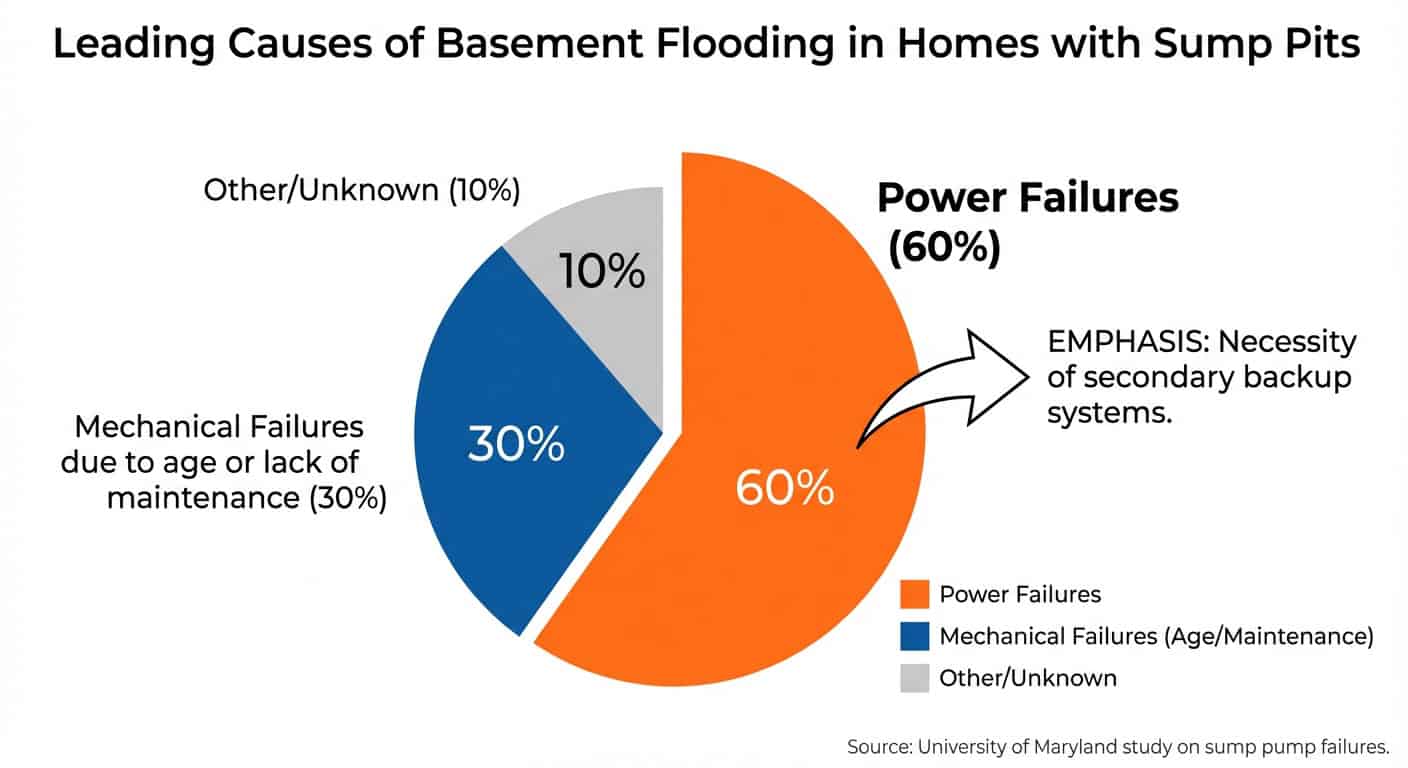
The University of Maryland’s research on urban flooding delivers a sobering statistic: 60% of basement floods in homes equipped with sump pits are caused by power failures. Not mechanical failure. Not overwhelmed capacity. Simple power loss. This means the majority of flooding damage is entirely preventable with proper backup systems.
Understanding Your Backup Options
The sump pump industry has developed two primary backup methodologies, each with distinct advantages and limitations based on your home’s specific characteristics.
Battery Backup Systems
Battery backup systems work by pairing your primary AC-powered pump with a secondary 12-volt DC pump powered by deep-cycle marine batteries (typically one or two batteries in parallel). When the power goes out, the battery system automatically activates, continuing to remove water from your pit.
How They Work: The system monitors incoming power continuously. The moment power is lost, a controller instantly switches operation to the battery-powered backup pump. These pumps can typically run for 4-7 hours on a fully charged battery, depending on cycling frequency and battery capacity.
Advantages:
- Complete Independence: Works regardless of municipal water pressure, well pump status, or any external infrastructure
- High Discharge Rate: Quality battery backup pumps can match or exceed primary pump capacity
- Proven Reliability: When properly maintained, battery systems provide dependable operation
Disadvantages:
- Battery Degradation: Deep-cycle batteries typically last 3-5 years before capacity drops below reliable levels. This means scheduled replacement is mandatory.
- Monitoring Requirements: You must periodically verify battery charge and test system functionality. Batteries that sit unused can sulfate and lose capacity.
- Initial Investment: Professional installation of a battery backup system typically ranges from $400-$800, including the pump, battery, charging system, and controller.
Water-Powered Backup Systems
Water-powered backup systems are elegantly simple, using municipal water pressure to create a venturi effect that siphons water from your pit without any electrical components.
How They Work: When your primary pump loses power, rising water in the pit triggers a float valve that opens a connection to your home’s water supply. High-pressure water flowing through a specially designed nozzle creates suction (the venturi effect) that pulls water from the pit and carries it into your drainage system.
Advantages:
- No Batteries: Since there are no batteries, there’s no degradation or replacement cycle
- Indefinite Runtime: As long as municipal water pressure remains available, the system can operate continuously
- Lower Maintenance: Simpler mechanical design means fewer components to monitor
Disadvantages:
- Municipal Pressure Dependency: Requires strong, consistent municipal water pressure (minimum 40-50 PSI). Not effective with well water systems where the well pump itself requires electricity.
- Water Consumption: Uses potable water to operate—approximately one gallon of municipal water per two gallons of sump water removed. This increases water bills during extended outages.
- Initial Investment: Professional installation typically ranges from $300-$600.
Sarkinen’s Regional Recommendations
Based on the specific characteristics of Vancouver and Portland area homes, here’s our professional guidance:
| Backup System Type | Best For |
|---|---|
| Battery Backup |
|
| Water-Powered |
|
The Ultimate Solution: Hybrid Systems
For maximum protection—particularly for homes in designated flood zones or areas with chronic water table issues—Sarkinen Plumbing recommends hybrid installations featuring both battery and water-powered backup systems. This redundancy ensures protection even if one backup system fails or becomes unavailable.
Consider this scenario: A major winter storm knocks out power (primary pump fails). Your battery backup activates and successfully protects your home for six hours. But the outage extends to 12 hours, exhausting your battery capacity. At that point, your water-powered backup takes over, providing continued protection until power is restored. This layered approach eliminates single points of failure.
Installation and Maintenance Requirements
Both backup systems require professional installation to ensure proper integration with your primary pump and to verify they’ll activate automatically when needed. Attempting DIY installation creates serious risks of improper configuration that won’t be discovered until an actual emergency.
Battery System Maintenance:
- Test system quarterly by unplugging primary pump and verifying battery backup activates
- Inspect battery terminals for corrosion every six months
- Replace batteries every 3-5 years or when capacity testing shows degradation below 70%
Water-Powered System Maintenance:
- Test system annually by shutting off primary pump power and verifying water-powered activation
- Inspect float valve mechanism for debris or mineral buildup
- Verify discharge connections remain secure
The 85% Solution
Let’s return to that University of Maryland research one final time, because the conclusion is profound: Homes implementing bi-annual maintenance schedules AND backup power systems reduced flooding incidents by 85%. Not 10% or 20%—85%. That’s nearly eliminating the risk of basement flooding through two straightforward interventions: regular maintenance and backup systems.
When you consider that a complete backup system installation costs $400-$800 while preventing $25,000+ in flood damage, the return on investment isn’t just favorable—it’s dramatic.
Don’t wait for the first November storm forecast to consider backup systems. Once severe weather is predicted, installation availability disappears as plumbers respond to emergency calls. The time to install backup protection is during calm weather, when installation can be scheduled, thoughtfully planned, and properly tested.
Sarkinen’s Seasonal Maintenance Checklist: Your Year-Round Protection Plan
Prevention is a continuous process, not a single event. The University of Maryland research demonstrating an 85% reduction in flooding risk specifically studied homes following bi-annual maintenance schedules—two comprehensive check-ups per year, strategically timed around the PNW rainy season.
Here’s Sarkinen Plumbing’s professional seasonal maintenance calendar, designed specifically for Portland-Vancouver area climate patterns:
Early Fall (September – October): Pre-Season Preparation
This is your critical preparation window before the October-March rainfall concentration begins.
Homeowner Tasks:
- Perform the complete bucket test protocol outlined earlier
- Visually inspect and clean the weep hole
- Test your backup system (unplug primary pump or shut off power to verify backup activates)
- Clear any debris, sediment, or gravel from the sump pit
- Inspect the discharge line exterior terminus to ensure it’s clear and directs water away from your foundation
- Check for ice formation risk points in exposed discharge piping
Professional Service (Recommended for pumps 5+ years old):
- Schedule a comprehensive inspection with Sarkinen Plumbing
- Professional cleaning of impeller and intake screen
- Motor bearing assessment and lubrication if accessible
- Check valve replacement if showing any signs of wear
- Discharge line pressure testing
- Electrical connection inspection and GFCI testing
- Battery capacity testing (if battery backup installed)
- Full system load testing under simulated high-influx conditions
Mid-Winter (January – February): Peak Season Verification
Your pump is working hardest during these months. This isn’t the time for invasive maintenance, but vigilance is essential.
Homeowner Tasks:
- After major storm events, perform a quick visual and auditory inspection
- Listen for any unusual noises during pump operation
- Verify backup system indicator lights show proper charging/standby status
- Check for ice formation in discharge lines during freezing periods
- Ensure the pump is cycling appropriately (15-30 second runs, not continuous or rapid cycling)
Professional Service (Only if issues detected):
- If you notice any warning signs during winter operation, don’t wait until spring—contact Sarkinen Plumbing for diagnostic service
- Emergency 24/7 availability for pump failures or flooding events
Late Spring (April – May): Post-Season Evaluation
The rainy season is ending. This is your opportunity to assess how your system performed and address any wear from the heavy operational period.
Homeowner Tasks:
- Perform a final bucket test now that rainfall has decreased
- Clean accumulated sediment from the sump pit
- Visually inspect pump housing and discharge connections for any signs of wear, stress, or damage
- Test backup systems again to ensure they remain functional for next season
Professional Service (Recommended annually):
- Schedule post-season inspection if you encountered any issues during winter
- Consider professional cleaning and component replacement if the pump worked harder than usual during the season
- This is the ideal time for pump replacement if your unit is approaching 7-10 years of age—replacing during calm weather rather than emergency conditions
What You Should Never Attempt
Some maintenance tasks are well within homeowner capabilities. Others create serious safety risks and should only be performed by licensed professionals:
⛔ Never Attempt:
- Motor disassembly or internal electrical repairs
- Check valve installation or replacement (requires precise positioning and pressure testing)
- Backup system installation or electrical integration
- Discharge line re-routing or drainage system modifications
- Pump replacement involving electrical panel connections
When to Contact Sarkinen Plumbing Immediately
- Your pump is 7+ years old and approaching fall season
- Any of the diagnostic tests described in this article fail
- You hear unusual operational noises (grinding, rattling, clicking, continuous humming)
- Your pump is short-cycling or running continuously
- You’re planning to install a backup system
- You want professional peace of mind through our annual inspection package
The Sarkinen Pre-Season Inspection Package
Every September and October, Sarkinen Plumbing offers comprehensive Pre-Season Sump Pump Inspection Packages designed specifically for PNW homeowners. Our licensed plumbers will:
- Perform complete operational testing using professional diagnostic equipment
- Clean and inspect all accessible components
- Test backup systems and replace batteries if capacity has degraded
- Provide written documentation of system condition
- Offer clear recommendations for any repairs or replacements needed before rainy season begins
- Give you complete peace of mind that your home is protected
The investment is minimal—typically $150-$300 depending on system complexity. The protection is comprehensive. And the alternative—discovering pump failure during a flood event—is unconscionable when prevention is this accessible.
Final Thoughts
Your sump pump is one of the hardest-working pieces of equipment in your home, operating silently in your basement or crawlspace, cycling on and off dozens of times per week during rainy season, protecting your foundation, your belongings, and your family’s safety from the unique hydrological challenges of Pacific Northwest weather.
Yet most homeowners never think about their sump pump until it fails—and by then, it’s too late. The water is rising. The damage is occurring. The emergency plumber is on the way, but your flooded basement doesn’t care about response times.
This guide has provided you with three critical pillars of sump pump protection:
- Regular Diagnostic Testing: The 15-minute bucket test protocol, performed each September or October, validates every critical component before you need them most. Float switch, motor function, discharge efficiency, check valve operation—these simple tests identify problems when they’re still fixable.
- Recognition of Warning Signs: Grinding noises, short-cycling, excessive vibration, and the simple reality of age—these aren’t minor annoyances to ignore. They’re your pump’s way of telling you it needs help before it can no longer protect your home.
- Backup System Installation: With 60% of basement floods caused by power failures, operating without backup protection isn’t just risky—it’s statistically reckless. Battery or water-powered systems aren’t luxury additions; they’re essential infrastructure in a region where falling trees and power outages coincide exactly with peak flood risk.
The financial mathematics are undeniable. A few hundred dollars in preventative maintenance and backup systems protects against tens of thousands in flood damage. The University of Maryland’s research shows an 85% risk reduction through bi-annual maintenance and backup installation. That’s not marginal improvement—that’s nearly eliminating flood risk entirely.
The window for action is now. With fall approaching, rainy season is weeks away, not months. Homeowners who schedule preventative service in September and October enjoy convenient appointment times, thoughtful system evaluations, and the peace of mind that comes from knowing their homes are protected. Those who wait until the first storm forecast face overwhelmed service schedules, emergency pricing, and the very real possibility of not getting help until after damage has already occurred.
Your sump pump is working 24/7 to protect your home’s foundation, your possessions, and your family’s safety and comfort. Isn’t it worth 15 minutes of testing and a professional inspection to ensure it’s ready for the challenges ahead?
Ready to Protect Your Home?
Schedule your pre-season sump pump inspection with Sarkinen Plumbing today. Don’t wait for the next atmospheric river—protect your home now.
Contact us at (360) 369-3586 or visit our contact page to schedule your appointment.
We’re available 24/7 for emergencies, but we’d much rather see you for preventative maintenance than emergency flood response.
References:
- National Weather Service. (2023). Portland, OR Climate Data – Annual Precipitation. National Oceanic and Atmospheric Administration. https://www.weather.gov/pqr/climate
- National Oceanic and Atmospheric Administration (NOAA). (2023). What are Atmospheric Rivers? https://www.noaa.gov/stories/what-are-atmospheric-rivers
- Washington State Department of Ecology. (2023). Floods and Runoff Pollution. https://ecology.wa.gov/Water-Shorelines/Water-quality/Runoff-pollution/Floods
- Federal Emergency Management Agency (FEMA) / National Flood Insurance Program. (2022). The Cost of Flooding. FloodSmart. https://www.floodsmart.gov/costs-of-flooding
- International Association of Certified Home Inspectors (InterNACHI). (2023). Sump Pump Inspection Basics. https://www.nachi.org/sump-pumps.htm
- North Dakota State University (NDSU) Extension. (2021). Sump Pump Questions and Answers. https://www.ndsu.edu/agriculture/extension/publications/sump-pump-questions-and-answers
- Department of Energy (DOE) & Pacific Northwest National Laboratory (PNNL). (2020). Resilience and Backup Power Systems for Residential Applications. https://www.energy.gov/eere/buildings/articles/home-backup-power
- University of Maryland, Center for Disaster Resilience. (2018). Urban Flooding Report: The Growing Challenge for U.S. Communities. https://cdr.umd.edu/urban-flooding-report
- Vancouver 360-369-3586
- Portland 503-925-3504




Vancouver Location
Proudly Serving
Portland and Vancouver
from Wilsonville to Longview &
Hillsboro to Gresham
UBI # 602-521-027
OR Contractor Lic# 170052 (CCB)
WA Contractor Lic# SARKIPI946MF
OR Plumber Lic# PB115
Customer Satisfaction
4.6 stars - Based on 227 Reviews







Quick Links
Plumbing Services
SW Washington Service Areas
Oregon Service Areas
Contact Information
Sarkinen PlumbingVancouver
9502 NE 72nd Ave
Vancouver, WA 98665
Phone: 360-369-3586
Portland
Phone: 503-925-3504
Hours of Operation
Monday - Sunday 24-hours