- Vancouver 360-369-3586
- Portland 503-925-3504

Vancouver & Portland Tap Water: Do You Need a Whole-Home Water Filtration System?
by writer | Dec 31, 2025
Table of Contents
- Portland’s Soft Water vs. Portland‘s Soft Water vs. Vancouver‘s Mineral-Rich Groundwater: Why Location Determines Your System
- Not All Carbon Filters Are Created Equal: The Science of Chloramine Removal
- Why Vancouver Homeowners Lose $800+ Every Year to Unfiltered Water
- Forever Chemicals and Lead Pipes: The Contaminants Municipal Treatment Can’t Stop
- Stop Guessing: The Right Water Treatment System for Your Address
Your water passes federal safety tests—but that doesn’t mean it’s protecting your $6,000 water heater or your family’s skin health. Here’s the reality most homeowners in the Vancouver-Portland metro area don’t realize: municipal water that meets EPA standards can still be slowly destroying your plumbing infrastructure, reducing appliance efficiency, and costing you hundreds of dollars annually in wasted energy and products. The Columbia River creates a chemical divide that makes water quality dramatically different on each side. Portland faces chloramine corrosion issues that eat through rubber seals and gaskets. Vancouver battles mineral scaling from groundwater sources that can cut the lifespan of a tankless water heater from 15 years to less than two. This isn’t about fear-mongering—it’s about asset protection. Gas water heaters operating on hard water lose up to 24% efficiency over their lifespan, translating to over $1,000 in wasted energy costs alone. This guide provides hydro-geological data and infrastructure analysis specific to your ZIP code, helping you make evidence-based decisions about whole-home filtration and softening systems. Whether you’re in Portland dealing with soft, aggressive water or Vancouver managing mineral-rich groundwater, understanding your water chemistry is the first step to protecting your home’s plumbing investment.
Portland’s Soft Water vs. Vancouver’s Mineral-Rich Groundwater: Why Location Determines Your System
The most important fact about water quality in the Portland-Vancouver metro area is this: your neighbor’s filtration solution likely won’t work for your home. The Columbia River creates a hydro-geological divide that dictates entirely different treatment approaches.
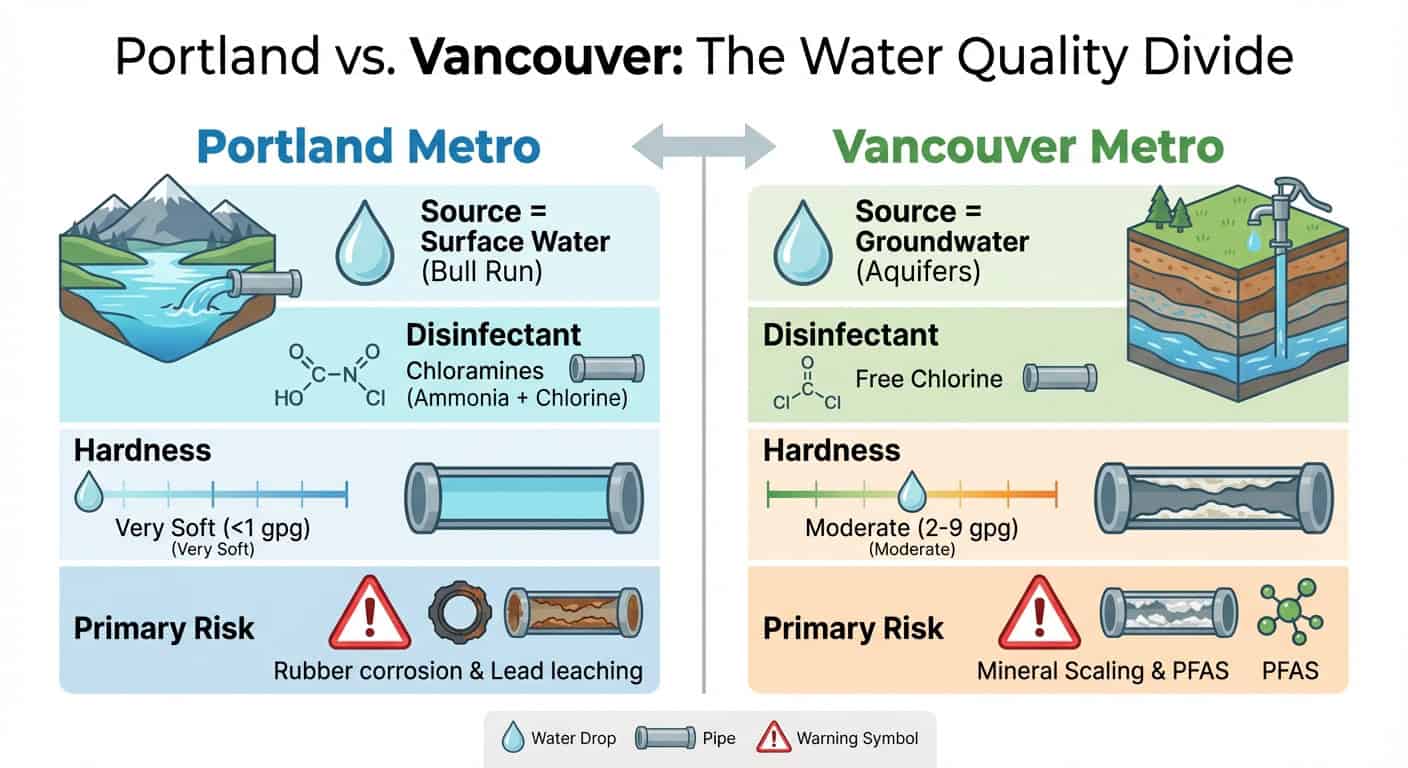
Portland’s Bull Run Watershed supplies the city with rain-and-snowmelt surface water that’s naturally soft—typically measuring less than 1 grain per gallon (gpg) of hardness. While this sounds ideal, soft water is naturally “hungry” for minerals, making it aggressive toward metal pipes. To combat this corrosivity, the Portland Water Bureau adjusts the pH to 8.2 using sodium carbonate and carbon dioxide, but homes with older copper piping (especially those with lead solder installed before 1986) remain vulnerable to metal leaching. Surface water also carries higher levels of organic matter compared to groundwater. While Portland’s treatment effectively manages this, seasonal fluctuations—particularly during heavy rainfall—can introduce turbidity that impacts standard sediment filters. Vancouver’s Aquifer System tells a completely different story. Water is drawn from the Orchards, Troutdale, and Sand-and-Gravel aquifers, where it has percolated through mineral-rich rock formations. This results in hardness levels ranging from 2 to 9 gpg—enough to cause scaling in pipes, water heaters, and appliances over time. But the story doesn’t end with calcium and magnesium. Vancouver’s water contains dissolved silica, which standard hardness tests don’t measure. Silica forms glass-like deposits on fixtures and shower doors that resist conventional acid cleaners, creating a maintenance headache that many homeowners attribute to “hard water” without understanding the true culprit.
| Parameter | Portland (Bull Run) | Vancouver (Aquifer) |
|---|---|---|
| Source Type | Surface Water | Groundwater |
| Hardness | <1 gpg (Very Soft) | 2–9 gpg (Soft to Moderate) |
| Primary Concern | Chloramines & Corrosivity | Mineral Scaling & Chlorine |
| Recommended System | Catalytic Carbon Filter | Softener + KDF/Carbon Filter |
Understanding this fundamental difference is critical. Your water treatment system shouldn’t be chosen based on what worked for someone in a different city—or even a different neighborhood. It needs to match the specific chemistry of water flowing through your pipes.
Not All Carbon Filters Are Created Equal: The Science of Chloramine Removal
The chemical your city uses to disinfect water determines what type of filtration system will actually work in your home. This isn’t a minor detail—it’s the difference between a $2,000 system that performs as promised and one that delivers virtually no benefit. Portland’s Chloramine Challenge centers on a compound most homeowners have never heard of. Chloramines—formed by bonding chlorine with ammonia—produce fewer regulated disinfection byproducts than free chlorine, which is why Portland Water Bureau adopted them. However, chloramines are highly corrosive to rubber components throughout your plumbing system. This explains the mystery of toilet flappers that need replacing every 18 months, washing machine gaskets that crack prematurely, and dishwasher seals that fail years before they should. The ammonia-chlorine bond breaks down elastomers—the rubber polymers used in seals and gaskets—at an accelerated rate. Here’s where most homeowners make a costly mistake: they assume any carbon filter will remove chloramines. Standard activated carbon—like the media in countertop pitchers or basic whole-home filters—is largely ineffective against chloramines. The ammonia-chlorine bond is too stable. Removing chloramines requires Catalytic Carbon, which has a chemically modified surface structure that promotes the breakdown of the chloramine molecule into components the carbon can then absorb. Vancouver’s Chlorine Problem is different but equally problematic. Free chlorine is highly volatile, which is why you notice that unmistakable “swimming pool” smell when you turn on your shower. Beyond the odor issue, free chlorine reacts with organic matter naturally present in groundwater to form Trihalomethanes (TTHMs) and Haloacetic Acids (HAA5)—disinfection byproducts linked to long-term health concerns in numerous studies. The good news? Free chlorine is far easier to remove than chloramines. High-quality activated carbon or Kinetic Degradation Fluxion (KDF) media effectively eliminates free chlorine and its associated byproducts—and these systems typically cost 20-30% less than catalytic carbon systems designed for chloramine removal.
The Filtration Trap: Understanding this chemistry prevents the common mistake of purchasing a system designed for the wrong disinfectant. A Vancouver homeowner installing a catalytic carbon system (designed for chloramines) pays a premium for technology they don’t need. A Portland homeowner installing standard carbon filtration (effective for chlorine but not chloramines) gets virtually no protection against the corrosive effects damaging their plumbing components. Your water’s disinfection method isn’t negotiable—it’s determined by your municipal water provider. But your filtration response must be precisely matched to the chemistry flowing through your pipes.
Why Vancouver Homeowners Lose $800+ Every Year to Unfiltered Water
Water hardness isn’t just about spotty glassware and soap scum—it’s an economic issue that affects your home’s most expensive plumbing infrastructure. The Battelle Memorial Institute conducted a comprehensive study that quantified exactly how much mineral-laden water costs homeowners, and the numbers are striking. The $6,000 Problem starts with your water heater. Gas water heaters operating on hard water—even at Vancouver’s moderate 5-7 gpg range—lose up to 24% efficiency over their 15-year lifespan. For a household with a $300 annual gas bill allocated to water heating, that translates to $1,080 in wasted energy over the heater’s service life. But the efficiency loss is only part of the story. Mineral deposits—primarily calcium carbonate—accumulate on heating elements and internal surfaces, forcing the system to work progressively harder to achieve the same temperature. This increased strain shortens the appliance’s functional lifespan, often requiring replacement years before a softened-water equivalent would fail. Tankless Water Heaters Face Critical Risk in hard water environments. These increasingly popular systems heat water on-demand using compact heat exchangers with narrow passages. Scale buildup in these passages can cause complete system failure in as little as 1.6 years without proper treatment or aggressive maintenance schedules. A tankless water heater replacement runs $2,000-4,000—a cost that proper water softening largely prevents.
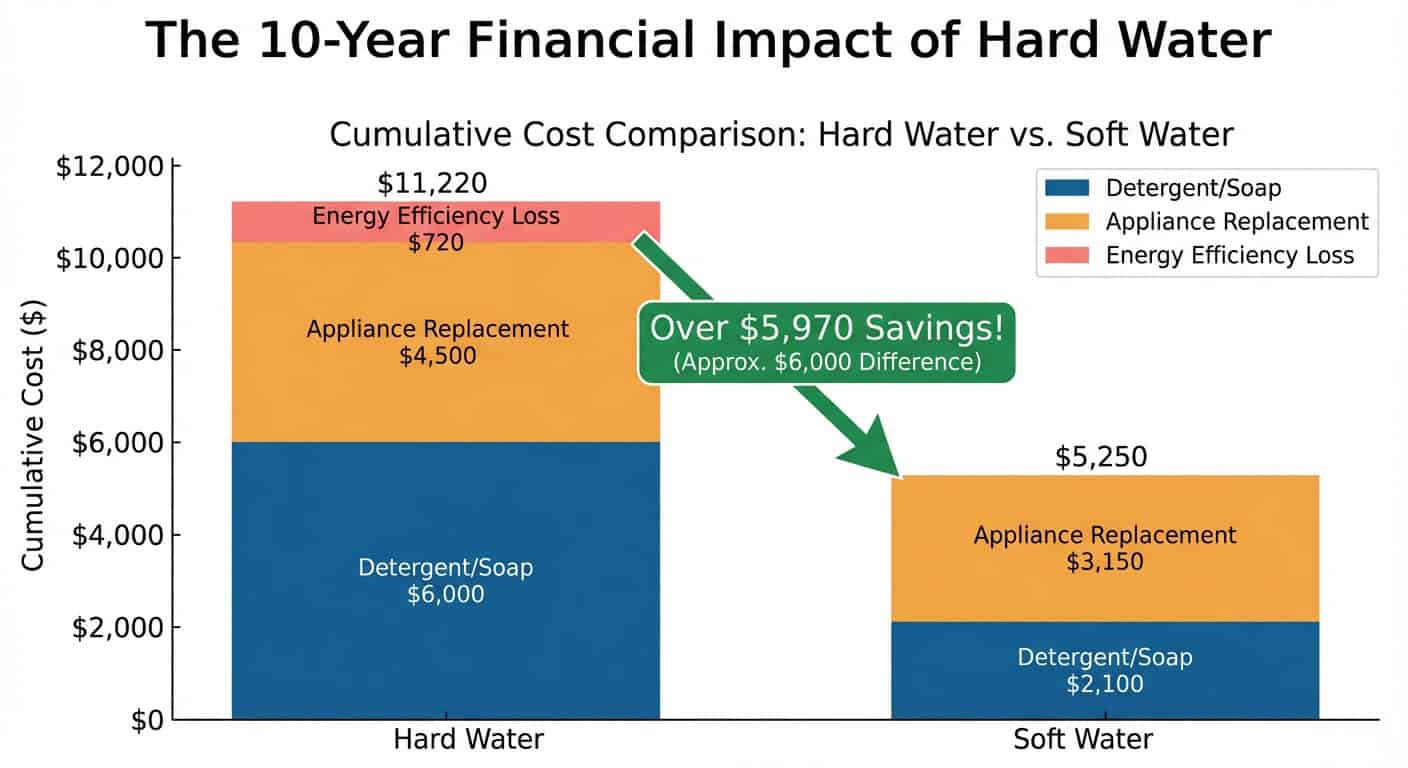
The Detergent Savings represent an often-overlooked economic benefit. The same Battelle study found that soft water allows for 50-70% reduction in soap and detergent use while achieving superior cleaning results at lower wash temperatures. For a family of four spending $600 annually on laundry detergent, dishwasher pods, and hand soap, that’s $300-420 in savings every year. The chemistry behind this is straightforward: hard water minerals bind with soap molecules, creating insoluble compounds that reduce cleaning effectiveness. Soft water allows surfactants to work as designed, meaning less product achieves better results. Appliance Lifespan Extension adds another economic dimension. The Battelle research documented that softened water extended dishwasher lifespan by 30% and washing machine lifespan by 20% compared to operation on hard water. When these appliances cost $800-1,200 to replace, the extended service life represents hundreds of dollars in deferred replacement costs.
| Expense Category | Annual Cost (Hard Water) | Annual Cost (Soft Water) | 10-Year Savings |
|---|---|---|---|
| Water Heater Energy Loss | $72/year | $0 | $720 |
| Detergent/Soap | $600 | $210 | $3,900 |
| Appliance Replacement (Amortized) | $450 | $315 | $1,350 |
| TOTAL | $1,122/year | $525/year | $5,970 |
The Investment Payback: A quality whole-home softener and filtration system typically costs $2,500-3,500 installed. Based on the cost analysis above, the system pays for itself in 2.2 years through energy savings and reduced product consumption alone—before accounting for avoided repair costs, extended appliance lifespans, or the elimination of recurring descaling maintenance. This isn’t about luxury or aesthetics. For Vancouver homeowners, water softening is a capital equipment protection strategy that delivers measurable return on investment. Every month without treatment represents accelerating damage to infrastructure that costs thousands to replace.
Forever Chemicals and Lead Pipes: The Contaminants Municipal Treatment Can’t Stop
Municipal water treatment plants effectively eliminate biological threats and reduce many industrial contaminants to safe levels. But a critical gap exists between water quality leaving the treatment facility and what flows from your tap. Two contaminant categories—PFAS and lead—highlight this “last mile” problem where whole-home or point-of-use filtration becomes essential. PFAS in Vancouver Wells represents an emerging threat that regulatory agencies are only beginning to address. Per- and polyfluoroalkyl substances—dubbed “forever chemicals” because they don’t break down in the environment—have been used for decades in firefighting foam, non-stick cookware, and water-resistant fabrics. In April 2024, the EPA finalized Maximum Contaminant Levels of 4.0 parts per trillion for PFOA and PFOS, two of the most studied PFAS compounds. Vancouver’s Water Station 14 has detected PFAS levels approaching these thresholds, prompting the city to blend water from multiple wells to reduce average concentrations across the distribution system. While this blending strategy keeps citywide averages below regulatory limits, homeowners served primarily by affected wells face higher exposure levels. The Blending Gamble creates an uncomfortable reality: your PFAS exposure depends partly on which well station supplies your neighborhood at any given time. Because PFAS concentrations vary between wells, and because the city rotates sources for operational reasons, your water quality fluctuates in ways the annual Consumer Confidence Report doesn’t capture. Standard carbon filters provide minimal PFAS reduction. Effective removal requires either Reverse Osmosis (RO) systems or specialized carbon block filters certified to NSF/ANSI Standard 53 or 58 specifically for PFAS reduction. These certifications mean the filter has been independently tested and verified to reduce PFAS below detectable limits under specified conditions.
Lead: The Infrastructure Problem demonstrates why “safe” water at the treatment plant doesn’t guarantee safe water at the tap. Lead contamination almost never originates at municipal facilities. Instead, it enters through lead service lines (the pipe connecting the water main to your home) or through copper pipes joined with lead solder, which was standard practice until the 1986 ban. Portland’s corrosion control treatment—adjusting pH to reduce the water’s aggressiveness—minimizes lead leaching but cannot eliminate it entirely in homes with lead-containing plumbing. Oregon Health Authority data shows that while Portland’s 90th percentile lead level measures 5.8 parts per billion (below the EPA action level of 15 ppb), approximately 10% of tested homes exceeded this threshold. Washington State faces similar challenges. While Vancouver’s groundwater is less corrosive than Portland’s surface water, homes built before 1986 remain at risk. The Point-of-Use Solution makes practical and economic sense for lead. Because contamination occurs within your home’s plumbing—not in the distribution system—whole-home filtration provides limited additional benefit compared to treating water at critical use points. A kitchen sink filter certified for lead reduction (NSF/ANSI Standard 53) protects drinking and cooking water at a fraction of the cost of whole-home treatment.
PFAS and Lead Testing: Vancouver residents can request PFAS data for their specific well source from the city’s Public Works Department. Both cities offer free or low-cost lead testing programs. Sarkinen Plumbing can coordinate testing and provide a written filtration recommendation based on your specific results—not generic marketing claims. The gap between municipal compliance and optimal home water quality isn’t about failures in public water systems. It’s about recognizing that “safe” is a baseline—not a target. When you understand what enters your pipes after treatment, and what contaminates water between the main line and your tap, the case for strategic home filtration becomes clear and evidence-based.
Stop Guessing: The Right Water Treatment System for Your Address
The filtration industry has convinced homeowners that more is always better—that every home needs softening, multiple stages of filtration, and reverse osmosis. This one-size-fits-all approach wastes money and often delivers minimal benefit. The prescriptive alternative starts with one question: What’s actually in your water?
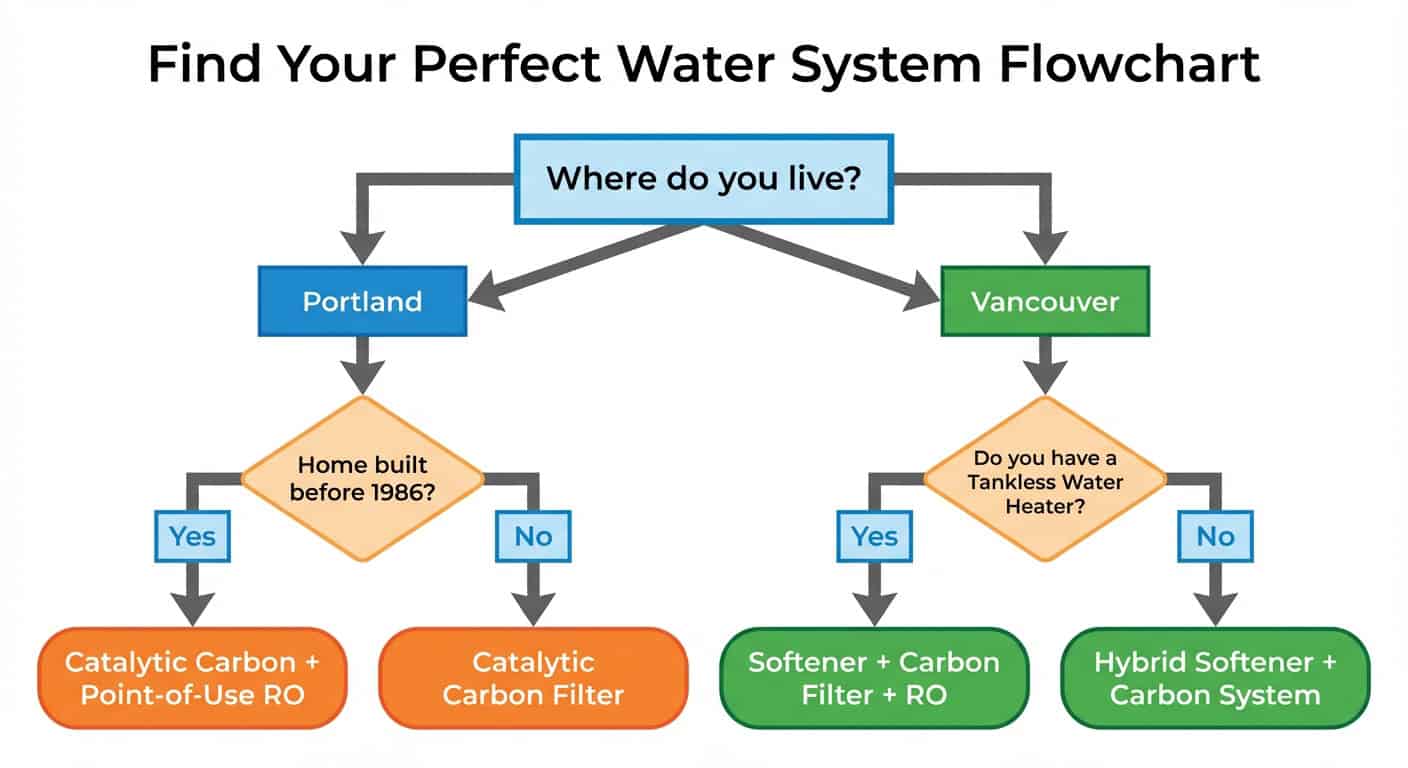
For Portland Residents, the primary system should target chloramine removal and corrosion protection. A whole-home Catalytic Carbon Filter addresses both issues—breaking down chloramines to protect rubber seals and removing organic compounds that contribute to taste and odor issues. Typical installation cost ranges from $1,800-2,500, with annual filter replacement running $150-200. Portland’s naturally soft water (under 1 gpg) makes softening systems unnecessary and potentially harmful. Water softeners replace calcium and magnesium with sodium, which adds unnecessary salt to already-soft water and can accelerate corrosion in certain pipe materials. The rare Portland homes on private wells may need softening, but municipal water customers should skip this expense entirely. Homes built before 1986 should add a kitchen sink lead-certified filter or RO system. Because lead enters through your home’s plumbing—not the Bull Run source—point-of-use protection makes more sense than whole-home treatment. Budget $400-800 for an under-sink RO system or $150-250 for a lead-certified carbon filter. For Vancouver Residents, the primary need is scale prevention combined with chlorine removal. A Hybrid Softener + Carbon Filter System addresses both mineral scaling and the aesthetic issues (taste, odor) associated with free chlorine. Installation typically costs $2,500-3,500 for a quality system sized appropriately for a 3-4 bathroom home. The softener component is non-negotiable if you have a tankless water heater. The narrow passages in heat exchangers become choked with scale rapidly—often causing expensive failures within 2-3 years on untreated water. The $2,500 investment in softening prevents a $2,000-4,000 heat exchanger replacement, making the payback period immediate for these homeowners. Vancouver residents near wells with detected PFAS (particularly those served by Water Station 14) should add a kitchen RO system for drinking and cooking water. Whole-home PFAS treatment is cost-prohibitive and creates excessive wastewater, making point-of-use systems the practical choice for most homes. The Diagnostic Difference separates Sarkinen Plumbing from competitors who push pre-packaged systems. Before recommending any equipment, we provide free water quality testing that measures:
- Hardness level (grains per gallon)
- Disinfectant type (chlorine vs. chloramine)
- Total Dissolved Solids (TDS)
- pH and alkalinity
- Iron and manganese (for well water customers)
This testing takes 15 minutes and provides the data necessary to prescribe—not guess—the appropriate system. “Done Right the First Time” means matching technology to chemistry, not upselling unnecessary components.
| Your Situation | Recommended System | Estimated Investment | ROI Timeline |
|---|---|---|---|
| Portland, post-1986 home | Catalytic Carbon Filter | $1,800–$2,500 | 3–4 years (appliance protection) |
| Portland, pre-1986 home | Catalytic Filter + RO | $2,400–$3,200 | 2–3 years (health + appliances) |
| Vancouver, modern plumbing | Softener + Carbon Filter | $2,500–$3,500 | 2.2 years (energy + detergent savings) |
| Vancouver, tankless heater | Softener + Carbon + RO | $3,200–$4,500 | 1.8 years (prevents $2,000 heat exchanger replacement) |
Maintenance Reality: All systems require maintenance. Carbon filters need replacement every 6-12 months ($100-200). Softeners need salt refills every 6-8 weeks ($15-25 per bag) and resin bed replacement every 10-15 years ($600-800). RO membranes last 2-3 years ($75-150 replacement). Factor these ongoing costs into your decision—they’re unavoidable regardless of brand or installer. The right system isn’t determined by marketing or neighbor recommendations. It’s determined by the specific mineral content, disinfectant chemistry, and contamination profile of water flowing through your address. Testing eliminates guesswork. Prescription eliminates waste.
Final Thoughts
Your municipal water supply meets federal safety standards—but those standards weren’t written to protect your $15,000 plumbing investment or optimize your family’s daily water quality. The baseline of “safe” doesn’t equal optimal, and the gap between the two costs Vancouver-Portland homeowners hundreds of dollars annually in wasted energy, shortened appliance lifespans, and increased product consumption. The Columbia River creates two fundamentally different water profiles separated by a few miles. Portland’s soft, chloramine-treated surface water demands different treatment than Vancouver’s mineral-rich, chlorinated groundwater. Trying to apply your neighbor’s solution to your home—especially if you live on opposite sides of the river—wastes money on equipment that doesn’t match your water chemistry. The economic case for properly matched filtration is clear and documented. Gas water heaters lose up to 24% efficiency on hard water. Tankless systems fail in less than two years without softening. Families waste $300-400 annually on excess detergent and cleaning products. These aren’t scare tactics—they’re findings from peer-reviewed research by the Battelle Memorial Institute and data from municipal water quality reports specific to your service area. Sarkinen Plumbing’s “Done Right the First Time” philosophy starts with testing, not selling. Free water quality analysis identifies your water’s specific chemistry—hardness, disinfectant type, contaminant profile—so recommendations are prescriptive rather than generic. Whether you need catalytic carbon filtration for Portland’s chloramines, a hybrid softener-filter system for Vancouver’s scaling, or point-of-use reverse osmosis for PFAS protection, the right system is determined by data, not marketing. The $2,500-3,500 investment in a properly matched whole-home system isn’t an expense—it’s insurance against premature failure of equipment costing thousands more to replace. It’s the difference between a tankless water heater lasting 1.6 years or 15 years. Between spending $600 annually on laundry detergent or $210. Between replacing toilet flappers every 18 months or every 5+ years. Water quality affects every drop flowing through your home, from the shower that starts your morning to the dishwasher running overnight. Municipal treatment gets water safely to your property line. What happens in the final 50 feet—from the main line to your tap—determines whether that water protects your plumbing investment or slowly destroys it.
Protect Your Investment
Contact Sarkinen Plumbing for a free consultation and water quality assessment. Let’s build a filtration system that works for your water, not just “water.”
References:
- Portland Water Bureau. (2023). 2023 Drinking Water Quality Report. https://www.portland.gov/water/water-quality/drinking-water-test-results
- City of Vancouver. (2024). Water Quality FAQ: Hardness and Silica. https://www.cityofvancouver.us/government/department/public-works/water/water-quality/
- Water Quality Association (WQA). (2024). Chloramine Fact Sheet. https://www.wqa.org/learn-about-water/common-contaminants/chloramine
- National Institutes of Health (NIH). (2015). Health Effects of Disinfection By-Products. https://www.ncbi.nlm.nih.gov/pmc/articles/PMC4665476/
- Battelle Memorial Institute / WQA. (2011). Softened Water Benefits Study. https://wqa.org/wp-content/uploads/2022/09/Battelle_Final_Report.pdf
- U.S. Environmental Protection Agency (EPA). (2024). Per- and Polyfluoroalkyl Substances (PFAS) in Drinking Water. https://www.epa.gov/sdwa/and-polyfluoroalkyl-substances-pfas
- City of Vancouver. (2023). PFAS Testing and Management. https://www.cityofvancouver.us/government/department/public-works/water/water-quality/pfas/
- Washington State Department of Health. (2024). Lead in Drinking Water. https://doh.wa.gov/community-and-environment/drinking-water/contaminants/lead
- Oregon Health Authority. (2022). Portland Water Bureau Corrosion Control Treatment. https://www.oregon.gov/oha/PH/HEALTHYENVIRONMENTS/DRINKINGWATER/OPERATIONS/Pages/Portland-Water-Bureau-Corrosion-Control-Treatment.aspx
- Vancouver 360-369-3586
- Portland 503-925-3504




Vancouver Location
Proudly Serving
Portland and Vancouver
from Wilsonville to Longview &
Hillsboro to Gresham
UBI # 602-521-027
OR Contractor Lic# 170052 (CCB)
WA Contractor Lic# SARKIPI946MF
OR Plumber Lic# PB115
Customer Satisfaction
4.6 stars - Based on 227 Reviews







Quick Links
Plumbing Services
SW Washington Service Areas
Oregon Service Areas
Contact Information
Sarkinen PlumbingVancouver
9502 NE 72nd Ave
Vancouver, WA 98665
Phone: 360-369-3586
Portland
Phone: 503-925-3504
Hours of Operation
Monday - Sunday 24-hours