- Vancouver 360-369-3586
- Portland 503-925-3504

How to Tell if Tree Roots Have Invaded Your Sewer Line in Portland & Vancouver
by writer | Mar 31, 2026

Table of Contents
- Why Do Tree Roots Invade Sewer Lines? Understanding Hydrotropism and Pipe Vulnerability
- The Hidden Responsibility: Understanding Your Sewer Lateral Liability
- 7 Red Flags That Tree Roots Have Invaded Your Sewer Line
- Say Goodbye to “Guess and Dig”—How CCTV Technology Pinpoints Root Intrusion
- Trenchless Technology: The Superior Solution for Root-Damaged Sewer Lines
- Final Thoughts
The Pacific Northwest’s lush urban canopy—featuring iconic Douglas Firs, Bigleaf Maples, and Oregon White Oaks—defines the beauty of Portland and Vancouver. But beneath this verdant landscape lies a silent threat to your home’s plumbing infrastructure: tree root intrusion. Root intrusion is the leading cause of sewer line backups in the United States, responsible for over 50% of all sanitary sewer overflows. In the PNW, where mature trees and aging clay or cast-iron pipes are commonplace, the problem is particularly acute. Many homeowners don’t realize they’re legally and financially responsible for maintaining their sewer lateral—the pipe running from their home to the municipal main—even when it’s buried beneath public sidewalks. This comprehensive guide will help you understand why tree roots attack sewer pipes, how to recognize early warning signs of root intrusion, why CCTV camera inspections are essential for accurate diagnostics, and how trenchless repair saves money, time, and your landscape compared to traditional excavation. Whether you’re dealing with slow drains or planning preventive maintenance, this article equips you with the knowledge to protect your home and make informed decisions about sewer line health.
Why Do Tree Roots Invade Sewer Lines? Understanding Hydrotropism and Pipe Vulnerability
Tree roots don’t maliciously target your plumbing—they’re biologically driven to seek moisture and nutrients, which aging sewer pipes inadvertently provide.
Hydrotropism Explained
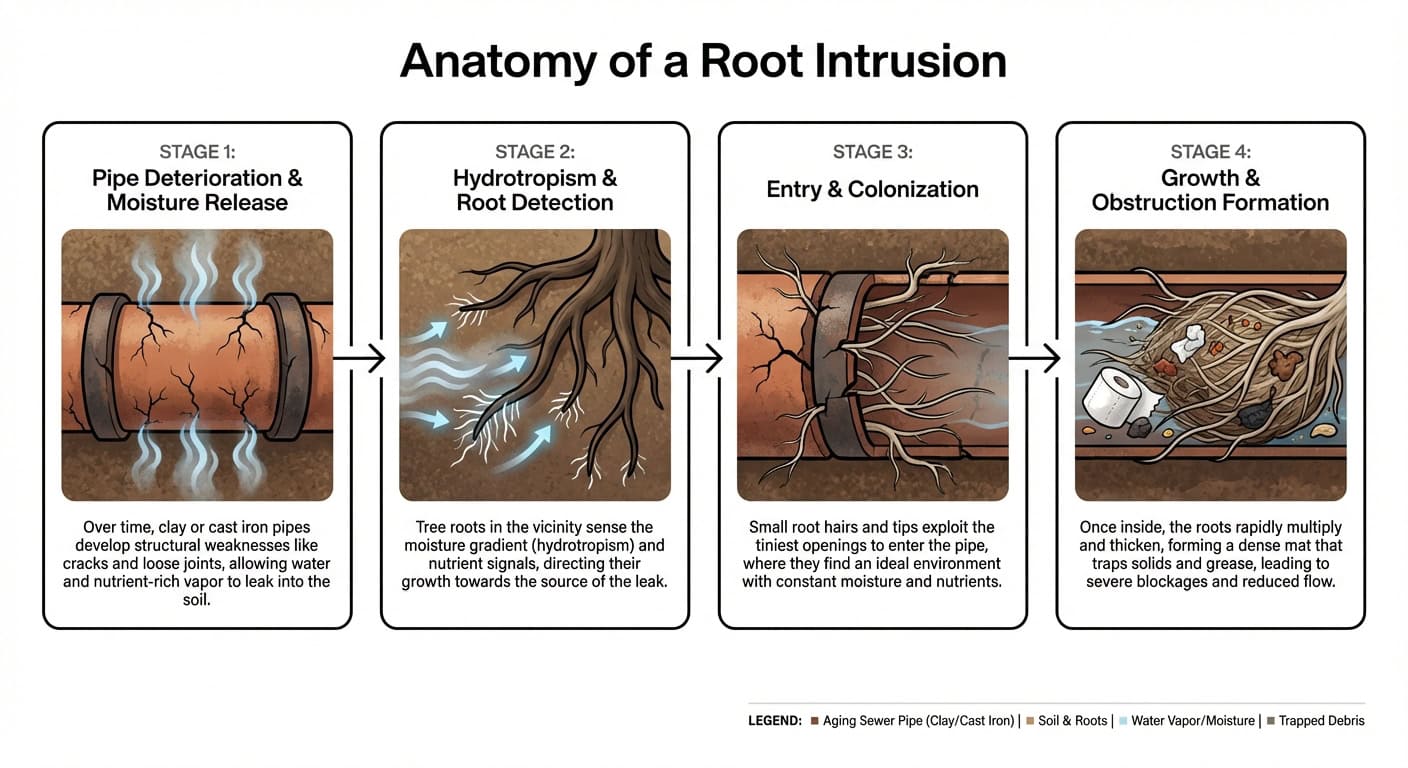
Tree roots grow toward moisture gradients through a process called hydrotropism. Residential sewer laterals carry warm, oxygenated, nutrient-rich wastewater that creates vapor escaping through micro-fissures in aging pipes. This vapor forms a moisture gradient in the surrounding soil that acts like a beacon for thirsty tree roots.
Pipe Vulnerability in the PNW
Homes built before the 1980s in Portland and Vancouver often have clay, cast iron, or Orangeburg pipes. These materials develop cracks over time due to soil settlement and seismic micro-tremors common in the region. Even the smallest crack or loose pipe joint becomes an entry point once roots detect the moisture signature.
The Root Mass Effect
Once roots penetrate a pipe joint, they proliferate rapidly inside the pipe, forming a dense “net” that catches grease, tissue, and organic waste until a complete blockage occurs. What starts as a hairline root intrusion can transform into a complete pipe obstruction within months.
Common PNW Culprits
Bigleaf Maple, Douglas Fir, and Oregon White Oak have particularly aggressive root systems that can extend two to three times the tree’s canopy width, putting most urban homes at risk. A mature Douglas Fir 30 feet from your home can easily have roots extending well beyond your sewer lateral.
The Hidden Responsibility: Understanding Your Sewer Lateral Liability
Most homeowners are surprised to learn they’re financially responsible for the entire sewer lateral, even portions running beneath public property.
Portland, OR Policy
According to the City of Portland Bureau of Environmental Services, property owners are responsible for maintenance, repair, and replacement of their sewer lateral from the house all the way to the connection at the public sewer main—including sections beneath sidewalks and streets. This means if your pipe fails under a city sidewalk or even in the street, you’re still on the hook for the repair costs.
Vancouver, WA Policy
Vancouver Public Works enforces a similar policy, placing the full financial burden of root-cleared and damaged laterals on the homeowner. There’s no grey area or shared responsibility—the lateral is entirely your concern.
Financial Implications
Without proper maintenance, a catastrophic sewer line failure can cost $8,000–$25,000 or more for emergency excavation and repair. When you factor in the cost of restoring your driveway, landscaping, or sidewalk, the total can easily exceed $30,000. Understanding your liability motivates proactive inspection and early intervention, which can save you tens of thousands of dollars.
7 Red Flags That Tree Roots Have Invaded Your Sewer Line
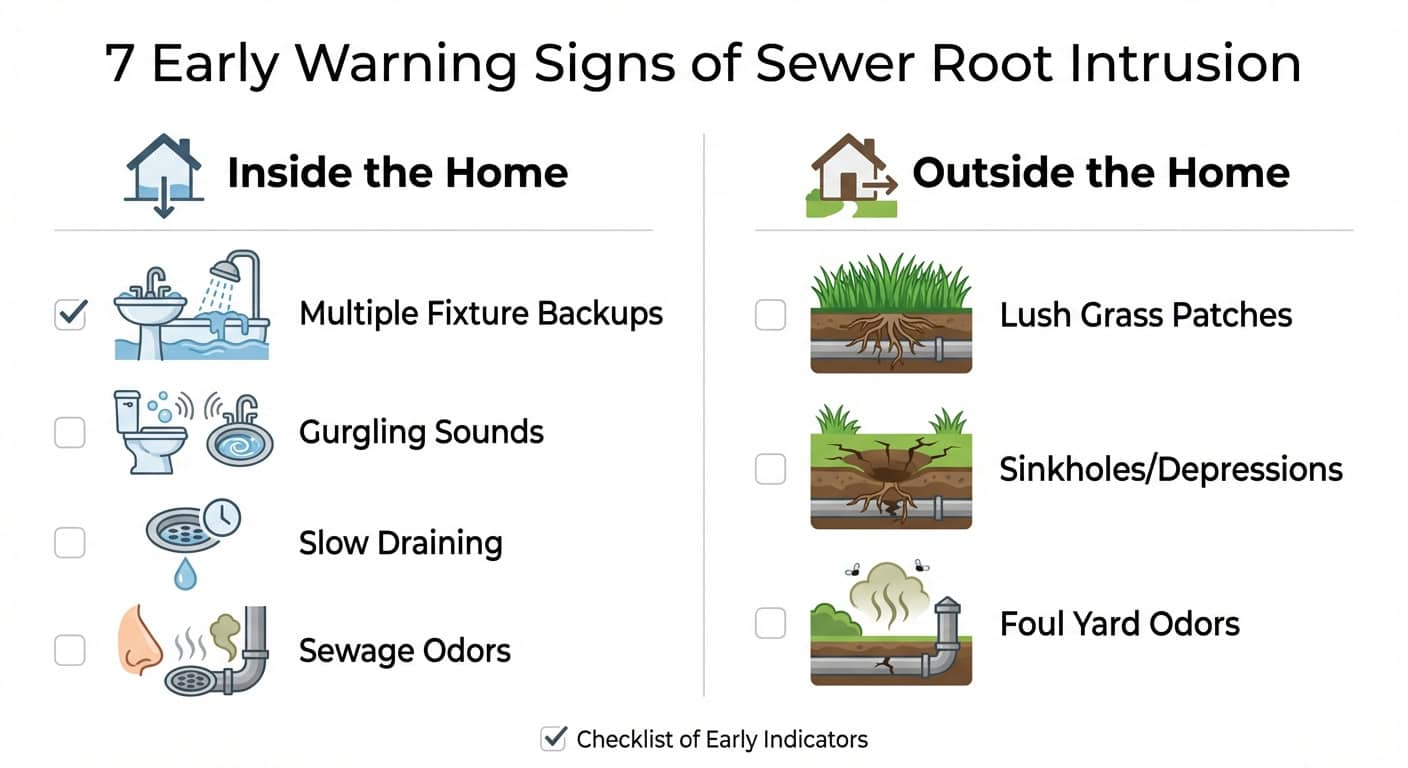
Recognizing the early symptoms of root intrusion can save you thousands in emergency repairs and property damage. Here are the warning signs every Portland and Vancouver homeowner should know:
Interior Warning Signs
1. Multiple Fixture Backups Unlike a localized clog that affects only one drain, root intrusion impacts the entire lower-level plumbing system. Water draining from a washing machine may back up into a ground-floor shower or toilet. If multiple fixtures are affected simultaneously, you’re likely dealing with a main line issue. 2. Gurgling Sounds As roots restrict pipe diameter, trapped air is displaced when water flows, causing distinctive gurgling noises in toilet bowls and drains. This sound indicates that water is struggling to push past an obstruction while forcing air back up through the plumbing system. 3. Slow, Progressive Draining A gradual reduction in drainage speed over weeks or months is a hallmark of creeping root growth, as opposed to sudden blockages caused by debris. If you notice that your drains are getting slower and slower despite cleaning efforts, roots may be the culprit. 4. Sewage Odors Indoors Persistent foul odors—the unmistakable smell of hydrogen sulfide gas—in bathrooms or basements indicate compromised pipe integrity. These odors occur when gases can’t escape through the normal venting system because roots are creating blockages.
Exterior Warning Signs
5. Unseasonably Lush Grass Patches Concentrated areas of vibrantly green, rapidly growing grass directly above the sewer lateral indicate vegetation is feeding on escaping sewage nutrients. These patches often remain green even during drought conditions when the rest of your lawn has browned. 6. Sinkholes or Ground Depressions As water leaks from root-compromised pipes, it washes away surrounding soil through subsurface erosion, creating dangerous sinkholes or uneven paving. What starts as a small depression can quickly become a hazardous collapse. 7. Foul Odors in the Yard The persistent smell of sewage in your yard is a clear indicator of a compromised lateral. This odor is particularly noticeable during warm weather when the escaping gases are more volatile.
“Tree roots will naturally exploit any source of moisture and nutrients, and sewer laterals represent an ideal target due to their consistent vapor release.” — Oregon State University Extension Service research on tree roots and infrastructure
Say Goodbye to “Guess and Dig”—How CCTV Technology Pinpoints Root Intrusion
Traditional sewer diagnostics required destructive excavation based on guesswork. Modern CCTV inspections provide precise, non-invasive diagnosis that protects your property while delivering accurate results.
How CCTV Inspections Work
A high-resolution, waterproof camera attached to a flexible fiber-optic push rod is inserted into the sewer cleanout. The camera transmits real-time video to a monitor, allowing technicians to identify the exact location, depth, and severity of root masses. The technician can even record the inspection for your records, providing visual proof of the problem and documentation for insurance purposes.
Industry Data on Accuracy
The North American Society for Trenchless Technology reports that CCTV diagnostics reduce unnecessary excavation by up to 90%, allowing technicians to pinpoint the exact linear foot of pipe defect. This precision means repair crews know exactly where to focus their efforts, minimizing disruption to your property.
Cost-Benefit for PNW Homeowners
For Portland and Vancouver homes with mature landscaping, hardscaping, or tree canopies, CCTV inspection is a necessary, non-destructive first step that protects property value. Instead of excavating multiple test holes to find the problem, a single camera inspection reveals everything you need to know.
What the Inspection Reveals
Beyond root intrusion, CCTV can identify:
- Pipe corrosion and material deterioration
- Bellied (sagging) pipes caused by soil settlement
- Offset joints where pipes have separated
- Foreign object blockages
- Scale buildup and mineral deposits
This comprehensive assessment gives you a complete picture of your sewer lateral’s condition, allowing you to prioritize repairs and plan for future maintenance.
Sarkinen Plumbing recommends CCTV inspections for homes built before 1980, properties with large trees within 50 feet of the sewer lateral, and any home experiencing slow drains or gurgling sounds. Think of it as a wellness check for your underground plumbing system—an investment that prevents catastrophic failure.
Trenchless Technology: The Superior Solution for Root-Damaged Sewer Lines
When roots have compromised your sewer line’s structural integrity, trenchless repair methods offer significant advantages over traditional open-trench excavation.
The Two Primary Trenchless Methods
Cured-in-Place Pipe (CIPP) A resin-saturated felt tube is inverted into the damaged pipe and cured using ambient heat, steam, or UV light. This creates a seamless “pipe within a pipe” that meets ASTM F1216 standards and is highly resistant to future root intrusion. The epoxy resin forms a structural barrier that roots simply cannot penetrate. Pipe Bursting A conical bursting head fractures the existing pipe outward while simultaneously pulling a seamless High-Density Polyethylene (HDPE) pipe into place. This method is ideal when the existing pipe is severely damaged or when upsizing the pipe diameter is desired.
Real-World Case Study
A neighborhood-wide lateral rehabilitation project in the Pacific Northwest featured homeowners facing massive costs to replace Orangeburg pipes deeply integrated with Douglas Fir root systems. By utilizing CIPP lining, contractors sealed the pipes without felling a single tree, resulting in a 40% cost reduction compared to excavation quotes while preserving the urban canopy.
Environmental & Aesthetic Benefits for PNW Homeowners
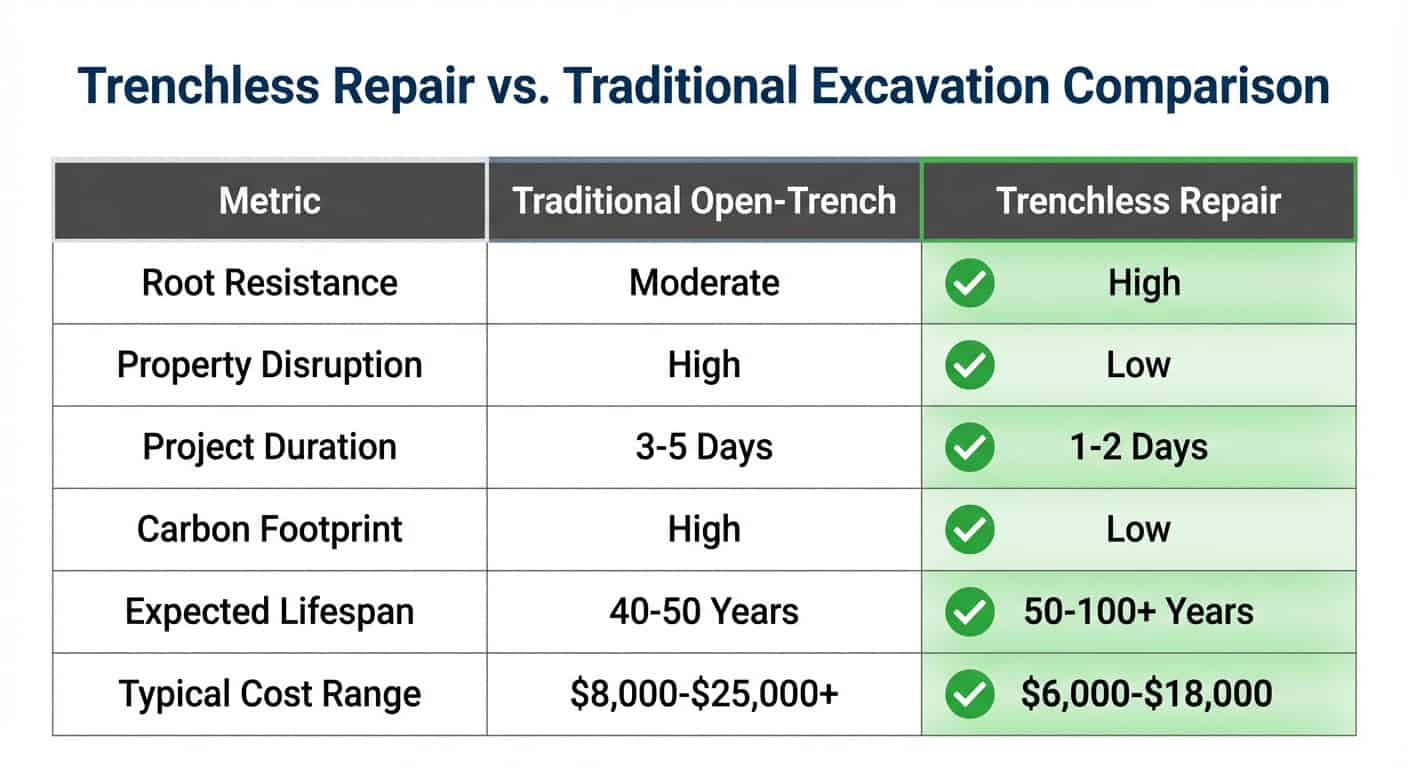
| Benefit | Trenchless Method | Traditional Excavation |
|---|---|---|
| Project Duration | 1-2 days | 3-5+ days |
| Landscape Disruption | Minimal (2 access points) | Extensive (entire lateral length) |
| Tree Preservation | 100% (no removal needed) | Often requires removal |
| Carbon Emissions | 75% reduction | Standard footprint |
| Expected Lifespan | 50-100+ years | 40-50 years |
| Hardscape Restoration Cost | $0 (no disruption) | $3,000-$15,000+ |
Protects Mature Trees There’s no need to remove beloved landscape features that may have taken decades to grow. Your property’s mature trees remain untouched, preserving both aesthetic value and property value. Preserves Driveways and Hardscaping Trenchless repair eliminates costly concrete or asphalt replacement. Your driveway, patio, walkways, and decorative stonework remain intact. Reduces Carbon Emissions Trenchless methods align with Portland and Vancouver’s sustainability values, reducing greenhouse gas emissions by up to 75% compared to traditional excavation. Less heavy machinery, less soil transport, and less waste all contribute to a smaller environmental footprint. Faster Project Completion While traditional excavation can take three to five days or longer, trenchless repair typically completes in one to two days. This means less disruption to your daily routine and faster restoration of your plumbing system. Superior Longevity Traditional pipe repairs may last 40-50 years, but modern trenchless solutions offer 50 to 100+ year lifespans. This means you’re likely installing a permanent solution that will outlast your homeownership.
Final Thoughts
Tree root intrusion is an inevitable challenge for Pacific Northwest homeowners, but it doesn’t have to result in landscape destruction and financial disaster. By understanding the biological mechanisms that drive roots into sewer pipes, recognizing early warning signs, and leveraging modern CCTV diagnostics, you can take proactive control of your home’s underground infrastructure.
Key Takeaways
- Tree roots seek moisture and nutrients from aging sewer pipes through natural hydrotropism
- Portland and Vancouver homeowners are legally and financially responsible for their entire sewer lateral—from house to main connection
- CCTV inspections provide precise, non-destructive diagnosis, eliminating guesswork and reducing unnecessary excavation by 90%
- Trenchless repair methods offer superior durability, faster completion, and minimal property disruption compared to traditional excavation
- Early detection and preventive maintenance can save you tens of thousands of dollars in emergency repair costs
If you’re experiencing slow drains, gurgling toilets, or have mature trees near your home, don’t wait for a catastrophic failure. Schedule a professional CCTV sewer inspection with Sarkinen Plumbing to assess your lateral’s condition and explore trenchless repair options that protect both your home and your landscape. Our experienced technicians serve the Portland and Vancouver metro areas with the latest diagnostic and repair technology, ensuring your underground infrastructure receives the expert care it deserves.
Ready to Protect Your Home from Root Intrusion?
Contact Sarkinen Plumbing today to schedule your sewer camera inspection and discover why hundreds of Pacific Northwest homeowners trust us with their most critical plumbing needs.
References:
- U.S. Environmental Protection Agency (EPA). (2004). Report to Congress: Impacts and Control of CSOs and SSOs. https://www.epa.gov/sites/default/files/2015-10/documents/csossos_rtc_2004.pdf
- Oregon State University Extension Service. (2020). Tree Roots and Infrastructure: Avoiding Conflict. https://extension.oregonstate.edu/forests/tree-care/tree-roots-infrastructure-avoiding-conflict
- WaterWorld Magazine. (2018). Dealing with the Root of the Problem in Sewer Systems. https://www.waterworld.com/wastewater/article/16200632/dealing-with-the-root-of-the-problem-in-sewer-systems
- City of Portland, Oregon – Bureau of Environmental Services. (2023). Sewer Line Responsibilities for Property Owners. https://www.portland.gov/bes/sewer-responsibilities
- City of Vancouver, Washington – Public Works. (2023). Sewer Maintenance and Responsibilities. https://www.cityofvancouver.us/publicworks/page/sewer-maintenance
- Purdue University – Department of Forestry and Natural Resources. (2021). Trees and Underground Utilities. https://www.extension.purdue.edu/extmedia/FNR/FNR-FAQ-12-W.pdf
- North American Society for Trenchless Technology (NASTT). (2022). Condition Assessment and CCTV Diagnostics. https://nastt.org/resources/condition-assessment/
- ASTM International. (2022). ASTM F1216-22 Standard Practice for Rehabilitation of Existing Pipelines and Conduits by the Inversion and Curing of a Resin-Impregnated Tube. https://www.astm.org/f1216-22.html
- U.S. Environmental Protection Agency (EPA). (1999). Wastewater Technology Fact Sheet: Trenchless Sewer Rehabilitation. https://www3.epa.gov/npdes/pubs/trenchle.pdf
- Trenchless Technology Magazine. (2021). The Lifespan of CIPP: A 50-Year Design Life Evaluated. https://trenchlesstechnology.com/the-lifespan-of-cipp/
- Trenchless Technology Magazine. (2019). Pacific Northwest Lateral Rehabilitation: A Case Study in CIPP. https://trenchlesstechnology.com/pacific-northwest-lateral-rehabilitation-case-study/
- Vancouver 360-369-3586
- Portland 503-925-3504




Vancouver Location
Proudly Serving
Portland and Vancouver
from Wilsonville to Longview &
Hillsboro to Gresham
UBI # 602-521-027
OR Contractor Lic# 170052 (CCB)
WA Contractor Lic# SARKIPI946MF
OR Plumber Lic# PB115
Customer Satisfaction
4.6 stars - Based on 227 Reviews





Quick Links
Plumbing Services
SW Washington Service Areas
Oregon Service Areas
Contact Information
Sarkinen PlumbingVancouver
9502 NE 72nd Ave
Vancouver, WA 98665
Phone: 360-369-3586
Portland
Phone: 503-925-3504
Hours of Operation
Monday - Sunday 24-hours