- Vancouver 360-369-3586
- Portland 503-925-3504
Tankless vs. Storage Tank Water Heaters: What’s Best for Large Families?
by writer | Dec 31, 2025
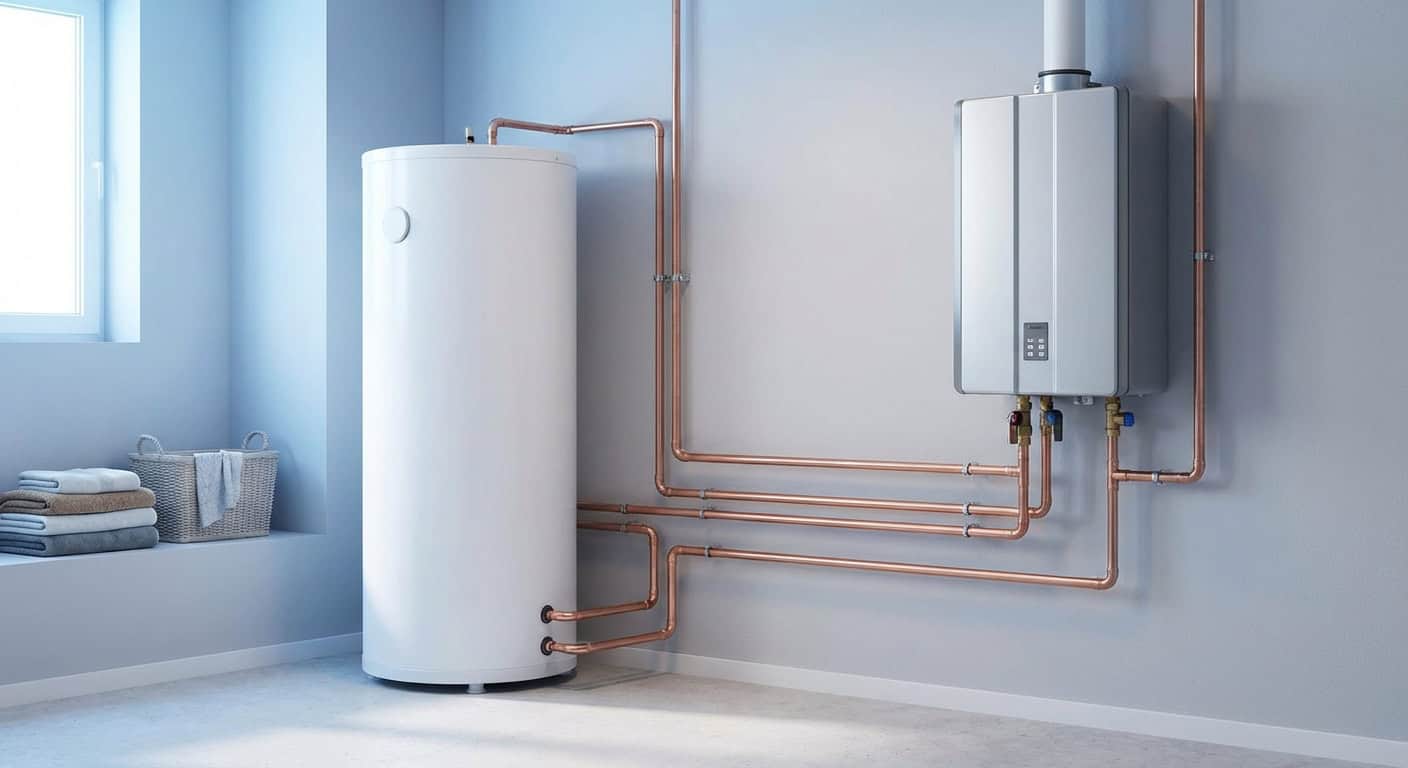
Table of Contents
- The Pacific Northwest “Delta T” Factor: Why Your Water Heater Works Harder Here
- Traditional Storage Tanks: Why “Old School” Might Be Perfect for Your Family
- Tankless Systems: The High-Efficiency Solution That Requires Strategic Planning
- Case Studies: How Vancouver & Portland Families Actually Use Hot Water
- The Financial Reality: Upfront Costs vs. Long-Term Savings (Plus 2024 Tax Credits)
- Final Thoughts
For families of four or more in the Vancouver, WA, and Portland, OR area, few household disruptions are more frustrating than running out of hot water mid-shower. Whether it’s the morning rush with multiple bathrooms in use or trying to run laundry while someone showers, your water heater is the unsung hero—or villain—of daily life. But here’s the challenge: the Pacific Northwest isn’t like Arizona or Southern California. Our cold groundwater temperatures—dropping as low as 45°F to 52°F in winter—fundamentally change how water heaters perform. A tankless system that works flawlessly in warmer climates may struggle to keep up during a PNW January. So which system is right for your family? This isn’t a simple “tankless is always better” or “tanks are outdated” answer. The decision depends on your household’s specific usage patterns, your home’s infrastructure, and whether you prioritize endless hot water or high simultaneous flow. In this comprehensive guide, we’ll break down the science behind both systems, compare their real-world performance in our region, and help you make an informed choice—with insights from Sarkinen Plumbing’s decades of experience serving Vancouver and Portland families.
The Pacific Northwest “Delta T” Factor: Why Your Water Heater Works Harder Here
Before comparing systems, families need to understand the thermodynamic reality that makes the PNW uniquely challenging for water heating. What is “Delta T”? Delta T (ΔT) is the temperature rise required—the difference between incoming cold water and desired hot water output (typically 120°F at the heater). This single metric determines how hard your water heater must work. The PNW Winter Challenge: While summer groundwater may reach 60°F, winter temperatures in the Vancouver/Portland area frequently drop to 45°F to 52°F. This means your heater must achieve a 70°F temperature rise—nearly double what’s required in warmer climates.

The Storage Tank Advantage: Traditional tanks are less affected by inlet temperature because water is pre-heated and stored. The insulated tank maintains temperature regardless of groundwater conditions. Real-World Scenario: For a family running two showers (2.5 GPM each = 5 GPM total) plus a dishwasher (1.5 GPM) simultaneously during a winter morning, a standard tankless unit is operating at absolute maximum capacity—with zero margin for additional demand.
Traditional Storage Tanks: Why “Old School” Might Be Perfect for Your Family

Storage tanks remain the most common residential water heating solution—and for large families with simultaneous demand, they offer distinct advantages over tankless systems.
How They Work:
- Stores 40-80 gallons of pre-heated water (120°F)
- Hot water is drawn from the top while cold water enters the bottom
- Gas or electric burner maintains temperature 24/7
The Critical Metric: First Hour Rating (FHR)
First Hour Rating measures total hot water available in the first hour: stored capacity plus recovery rate. A standard 50-gallon gas tank typically has an FHR of 80-90 gallons—more than enough for back-to-back showers. This metric is more important than tank size alone for large families.
Pros for Large Families:
Simultaneous High Flow: Flow rate is determined by household water pressure, not heating capacity. Three showers can run at full pressure simultaneously until the tank depletes. Lower Upfront Cost: Installation costs are typically 2-3 times less than comparable tankless systems, especially if no gas line upgrades are required. Consistent Performance: PNW winter temperatures don’t affect a tank’s ability to deliver pre-heated water at full pressure. Simpler Maintenance: Annual anode rod inspection and occasional flushing—less intensive than tankless descaling.
Cons for Large Families:
The “Recovery Cliff”: Once stored water is depleted, there’s a distinct gap. Gas units recover 40-50 gallons per hour; electric units only 12-20 gallons per hour. Standby Energy Loss: Energy is consumed maintaining water temperature 24/7, even when you’re asleep or on vacation—contributing to higher utility bills. Shorter Lifespan: Typical lifespan of 10-15 years due to tank corrosion from standing water. Space Requirements: Floor-mounted units occupy 9-12 square feet—valuable real estate in PNW basements and garages.
Best For:
- Families who need simultaneous high-flow usage (multiple showers plus appliances running at once)
- Homes with predictable, concentrated usage patterns (morning rush, evening routines)
- Budgets prioritizing lower upfront costs over long-term efficiency savings
Tankless Systems: The High-Efficiency Solution That Requires Strategic Planning
Tankless water heaters promise endless hot water and superior energy efficiency—but PNW families must understand their limitations and infrastructure requirements.
How They Work:
- No storage tank; water is heated instantly as it flows through a high-powered heat exchanger
- High-BTU burners (up to 199,000 BTU) activate only when hot water is demanded
- Wall-mounted, compact design saves valuable floor space
Pros for Large Families:
Truly Endless Supply: As long as fuel flows, hot water never runs out—ideal for families with sequential shower schedules (back-to-back showers over 1-2 hours). Superior Longevity: Typical lifespan of 20+ years—nearly double that of storage tanks—because there’s no standing water causing corrosion. Energy Efficiency: High-efficiency condensing models achieve 0.90 to 0.97 UEF (Uniform Energy Factor) compared to storage tanks’ 0.58-0.64 UEF. The U.S. Department of Energy reports 8-14% energy savings for high-demand households. Space Optimization: Wall-mounted units free up 9-12 square feet of floor space. Federal Tax Credits: As of 2024, homeowners can claim 30% of project cost (up to $600) for ENERGY STAR-certified tankless units.

Cons for Large Families in the PNW:
The Simultaneity Problem: During PNW winters, a standard tankless unit delivering 5.4 GPM at 70°F rise struggles when demand exceeds capacity. Running laundry, dishwasher, and two showers simultaneously will cause the unit to throttle flow to maintain temperature—resulting in weak water pressure. The “Cold Water Sandwich” Effect: If someone briefly turns off the shower (while soaping up), then turns it back on, a slug of cold water may pass through before the burner reactivates. Higher Installation Costs: Switching from tank to tankless often requires:
- Gas line upgrades from ½” to ¾” to handle 199,000 BTU demand
- New venting (PVC for high-efficiency condensing units)
- Electrical upgrades for electronic ignition and controls
- Total installation costs can be 2-3x higher than tank replacements
Mandatory Maintenance: Manufacturers require annual descaling flushes (circulating vinegar solution) to prevent mineral buildup in the heat exchanger—critical for maintaining warranty and efficiency.
Best For:
- Families with sequential usage patterns (showers spread over time rather than simultaneous)
- Households willing to coordinate high-demand activities (avoiding laundry/dishwasher during shower times)
- Homeowners prioritizing long-term energy savings and environmental impact over upfront costs
- Homes with adequate gas infrastructure or budget for upgrades
Case Studies: How Vancouver & Portland Families Actually Use Hot Water

Theory meets practice. Here’s how different family usage patterns determine the best water heating solution.
Scenario A: The “Morning Rush” Family (5 Members)
Location: Vancouver, WA
Routine: Everyone leaves between 7:00-8:00 AM
Peak Demand: Two showers running simultaneously (5 GPM total) plus intermittent bathroom sink use Tankless Outcome: A 199,000 BTU unit delivering 5.4 GPM at 70°F rise operates at maximum capacity. If kitchen faucet or dishwasher turns on during showers, water pressure drops noticeably. System can work—but requires family coordination (no laundry/dishes during shower time). Storage Tank Outcome: An 80-gallon gas tank handles simultaneous flow effortlessly at full pressure. Limitation: If a 6th person needs a shower immediately after, they’ll experience the “recovery cliff”—lukewarm water until the tank reheats.
Scenario B: The “Sequential Shower” Family (6 Members)
Location: Portland, OR (East Side)
Routine: Staggered schedules—showers happen over a 2-3 hour window
Usage Pattern: Back-to-back showers, but rarely simultaneous Tankless Outcome: Perfect application. Endless hot water means the 6th person gets the same hot shower as the 1st person. No “recovery wait” between showers. Energy savings accumulate over time due to no standby heat loss. Storage Tank Outcome: First 2-3 showers drain the tank. Remaining family members experience lukewarm showers or must wait 45-60 minutes between uses.
Scenario C: The “Luxury Home” Family (6+ Members, Large Soaking Tub)
Location: Portland, OR (West Hills)
Routine: High evening demand; 80-gallon soaking tub used regularly
Challenge: Large tubs require high flow, not just temperature Standard Tankless Outcome: A single tankless unit cannot fill a large tub quickly while other fixtures run. Filling the tub becomes frustratingly slow. Advanced Solution:
- Cascading Tankless System: Two units linked via communication cable. When demand is low, one unit operates; when demand spikes, the second activates automatically—providing 10+ GPM combined.
- Hybrid Approach: Tankless unit feeding a small buffer storage tank for high-volume draw events
Storage Tank Outcome: An 80-gallon tank can fill the tub once—but recovery time means the family must plan around tub usage.
The Financial Reality: Upfront Costs vs. Long-Term Savings (Plus 2024 Tax Credits)
Understanding the true cost of ownership—including installation, operation, maintenance, and available incentives—is critical for making an informed decision.
Installation Costs (2024 Pacific Northwest Averages):
| System Type | Installation Cost | Notes |
|---|---|---|
| Storage Tank (50-80 gallon gas) | $1,200 – $2,500 | Lower cost if replacing existing tank with similar configuration |
| Tankless (High-BTU condensing) | $3,000 – $5,500 | Premium for gas line upgrades, new venting, electrical work |
Operating Costs & Efficiency:
Storage Tanks: UEF ratings of 0.58-0.64
- Continuous standby energy loss (keeping water hot 24/7)
- Estimated $400-600/year in energy costs for large families
Tankless: UEF ratings of 0.90-0.97
- Zero standby loss—energy used only when hot water is demanded
- Estimated $300-450/year in energy costs for large families
- Annual savings: $100-150 for high-demand households

Payback Timeline: With a $2,000-3,000 premium for tankless installation and $100-150/year savings, the break-even point is typically 15-20 years. However, factoring in 20+ year lifespan versus 10-15 years for tanks, the long-term value proposition improves significantly.
2024 Tax Credits & Rebates:
Federal Tax Credit: 30% of project cost (up to $600) for ENERGY STAR-certified tankless units
- Reduces effective installation cost by $600
- Significantly improves ROI timeline
Energy Trust of Oregon: Offers cash rebates for high-efficiency tankless installations
- Typically $200-400 depending on unit efficiency
Washington State Utilities: Some local utilities offer additional incentives
- Check with Clark Public Utilities or your local provider
Effective Cost Example:
- Tankless installation: $4,500
- Federal tax credit: -$600
- Energy Trust rebate: -$300
- Net cost: $3,600
- With $125/year savings, payback timeline drops to ~12 years—well within the unit’s lifespan
Maintenance Costs:
- Storage Tanks: Anode rod replacement every 3-5 years (~$150-250)
- Tankless: Annual descaling flush (~$150-200) or DIY with vinegar
Final Thoughts
Choosing between tankless and storage tank water heaters for your Pacific Northwest home isn’t about which technology is “better”—it’s about which system aligns with your family’s specific hot water demands and lifestyle.
Choose a large-capacity storage tank (75-80 gallons) if:
- Your family needs simultaneous high-flow usage (multiple showers plus appliances running at once)
- You want lower upfront costs and simpler installation
- Coordinating usage schedules isn’t practical for your household
Choose a high-efficiency tankless system (199,000 BTU minimum) if:
- Your priority is endless hot water for sequential showers
- You value long-term energy savings and environmental efficiency
- You’re willing to invest in proper installation and annual maintenance
- Your family can coordinate high-demand activities
For luxury homes or very large families (6+ members): Consider advanced solutions like cascading tankless systems or hybrid approaches that combine the best of both technologies. The bottom line? There’s no universal “right answer”—but with 2024’s federal tax credits and local rebates, tankless systems have never been more financially accessible for PNW families making the long-term investment.
Ready to Make the Right Choice for Your Home?
Sarkinen Plumbing has been helping Vancouver and Portland families make informed water heater decisions for decades. Whether you need a storage tank replacement or want to explore tankless options, we provide honest assessments and expert installations.
References:
- U.S. Geological Survey (USGS). (n.d.). Groundwater Temperature Map of the United States. https://ngmdb.usgs.gov/Prodesc/proddesc_19851.htm
- Navien. (2024). NPE-2 Series Specifications (Flow Rates at Delta T). https://www.navieninc.com/series/npe-2
- A.O. Smith. (2023). Understanding First Hour Rating. https://www.hotwater.com/resources/what-is-first-hour-rating/
- Angi. (2024). Cost to Install a Water Heater. https://www.angi.com/articles/how-much-does-water-heater-installation-cost.htm
- Consumer Reports. (2023). Tankless Water Heaters vs. Storage Tank Water Heaters. https://www.consumerreports.org/water-heaters/tankless-water-heaters-vs-storage-tank-water-heaters-a5291982593/
- ENERGY STAR. (2024). Water Heater Key Product Criteria. https://www.energystar.gov/products/water_heaters/residential_water_heaters_key_product_criteria
- U.S. Department of Energy. (2023). Tankless or Demand-Type Water Heaters. https://www.energy.gov/energysaver/tankless-or-demand-type-water-heaters
- ENERGY STAR. (2024). Federal Income Tax Credits and Incentives for Energy Efficiency. https://www.energystar.gov/about/federal_tax_credits/water_heaters_natural_gas_oil_propane
- Energy Trust of Oregon. (2024). Incentives for Gas Water Heaters. https://www.energytrust.org/residential/incentives/water-heating/
- Plumbing & Mechanical Magazine. (2022). Cascading Tankless Systems: A Solution for High Demand. https://www.pmmag.com/articles/104123-cascading-tankless-water-heaters-provide-redundancy-efficiency
- Rinnai. (2023). Tankless Water Heater with Recirculation Technology. https://www.rinnai.us/residential/tankless-water-heaters/recirculation
- This Old House. (2023). Is a Tankless Water Heater Right for You? https://www.thisoldhouse.com/plumbing/21015555/is-a-tankless-water-heater-right-for-you
- Bob Vila. (2023). How to Flush a Tankless Water Heater. https://www.bobvila.com/articles/how-to-flush-tankless-water-heater/
- Vancouver 360-369-3586
- Portland 503-925-3504




Vancouver Location
Proudly Serving
Portland and Vancouver
from Wilsonville to Longivew &
Hillsboro to Gresham
UBI # 602-521-027
OR Contractor Lic# 170052 (CCB)
WA Contractor Lic# SARKIPI946MF
OR Plumber Lic# PB115
Customer Satisfaction
4.6 stars - Based on 227 Reviews






Quick Links
Plumbing Services
SW Washington Service Areas
Oregon Service Areas
Contact Information
Sarkinen PlumbingVancouver
9502 NE 72nd Ave
Vancouver, WA 98665
Phone: 360-369-3586
Portland
Phone: 503-925-3504
Hours of Operation
Monday - Sunday 24-hours